As a former teacher, I have 11 years’ worth of lesson plans that I am slowly rolling out that I want to share with you. Most of them below are free for you to use, but some are paid.
All of them are based on the 2004, 2008, and 2012 Virginia Standards of Learning (SOLs).
I also enjoyed teaching Civics and Economics, as well as Government, and am slowly adding my plans. One unit I was able to shoehorn into my teaching was The Stock Market Game. I taught those courses for about 6 years.
At one point, I was scheduled to teach AP Psychology, but that fell through. I ended up with some limited lesson plans.
Lesson Plans World History II SOL 11a League of Nations
Standard:
The student will demonstrate knowledge of political, economic, social, and cultural developments during the Interwar Period
Objective:
Describing the League of Nations and the mandate system.
Essential Knowledge
League of Nations
-International Cooperative Organization
-Established to prevent future wars
-United States not a member
-Failure of League because it did not have power to enforce its decisions
The mandate system • During World War I, Great Britain and France agreed to divide large portions of the Ottoman Empire in the Middle East between themselves.
• After the war, the “mandate system” gave Great Britain and France control over the lands that became Iraq, Transjordan, and Palestine (British controlled) and Syria and Lebanon (French controlled).
• The division of the Ottoman Empire through the mandate system planted the seeds for future conflicts in the Middle East.
Lesson Plans World History II SOL: 11c Rise of the Dictators
Standard WH II: The student will demonstrate knowledge of political, economic, social, and cultural developments during the Interwar Period by
Objectives: examining events related to the rise, aggression, and human costs of dictatorial regimes in the Soviet Union, Germany, Italy, and Japan, and
Lesson Plans
Introduction: A Bell-ringer activity
Notes: Students copy-down and discuss teacher generated notes
Activities: Students complete various in class activities to support learning including video analysis, maps, charts, diagrams, graphic organizers, worksheets, text-book questions, group discussion, KWL Charts etc.
Assessment: Informal, Formal, Exit-Questions, Teacher Questioning. Quizzes, Tests, Projects
Essential Knowledge:
U.S.S.R. during the Interwar Period — Joseph Stalin
• Entrenchment of communism
• Stalin’s policies: Five-year plans,
• Great Purge
Germany during the Interwar Period — Adolf Hitler
Anti-Semitism
Inflation and depression
Democratic government weakened
Extreme nationalism
National Socialism (Nazism)
German occupation of nearby countries
Italy during the Interwar Period — Benito Mussolini
Rise of fascism
Ambition to restore the glory of Rome
Invasion of Ethiopia
Japan during the Interwar Period — Hirohito and Hideki Tojo
Militarism
Industrialization of Japan, leading to drive for raw materials
• Invasion of Korea, Manchuria, and the rest of China
Lesson Plans World History II SOL 10b: Treaty of Versailles
Standard WH II: The student will demonstrate knowledge of the worldwide impact of World War I by
Objectives: explaining the outcomes and global effect of the war and the Treaty of Versailles.
Lesson Plans
Introduction: A Bell-ringer activity
Notes: Students copy-down and discuss teacher generated notes
Activities: Students complete various in class activities to support learning including video analysis, maps, charts, diagrams, graphic organizers, worksheets, text-book questions, group discussion, KWL Charts etc.
Assessment: Informal, Formal, Exit-Questions, Teacher Questioning, Quizzes, Tests, Projects
Essential Knowledge:
Major leaders
Woodrow Wilson
Kaiser Wilhelm II
Outcomes and global effect
• Colonies’ participation in the war, which increased demands for independence
• End of the Russian Imperial, Ottoman, German, and Austro-Hungarian empires
• Enormous cost of the war in lives, property, and social disruption
Treaty of Versailles
Forced Germany to accept responsibility for war and loss of territory and to pay reparation
Limited the German military
League of Nations
Activities That Support Lesson Plans
Treaty of Versailles Simulation: Students are divided into groups that represent players at the peace conference. Students role play as diplomats and work out a peace based on their national interests. I normally assign each student to a country. Once in groups students select their roles and then they receive their countries packets which contain character sheets, option sheets, and answer sheets. Once nations have selected their options they go to other countries to try to get support. After the diplomat stage, we discuss and the class votes which option to go with.
The Stock Market Game is reserved for my Senior Government classes. They do not have a state-test to take and it is easier to plan the time it takes to set-up and play. The Stock Market Game has a cost associated with it. For the past five years I have always found the money by applying for various grants particularly through Bayport Credit Union: Bayport Credit Union Grant.
To set-up the Stock Market Game I plan a curriculum that teaches students the basics of the game, how to read financial information, how to compare stocks, and how to search for stocks.
1. Stock Market Game Introduction Activities
The first activity is an outline of key vocabulary terms, what the stock market is etc. I also explain to students WHY we are doing this and how to win. I use a KWL Chart, notes, reading, and videos:
KWL Chart: Students create a 3-column sheet. The Topic is the Stock Market. Students fill in what they know and what they want to know about it. They will fill in the “L” column with what they learned about the Stock Market after the game is over.
Stock Market Video(Youtube) and Stock Market Video Questions : I’ve tried finding various stock market videos that give a good generally outline of how it works. The best I have found is from the 1950s/1960s which, as reflective of the times, comes across as sexist and lacks diversity. I’ve included it but if someone knows of a better video please let me know.
2. Quiz:
After the introduction is complete I normally give the students a quiz over the information. Either I make the quiz-up or I use a quiz given by the Stock Market Game. Note: These quizzes may be out of date.
3. Stock Market Game Skills: The next activities involve learning how to read stock information and how to search for it. I encourage students to use NYSE , NASADAQ ,or Google Finance to search for stock market information.
Jim’s Birthday Present Activity : I use this as a review of the above information. They brainstorm companies in bold. These will be used later on.
How to Interpret Stock Data from Internet: A handout with important stock terms. Students read the terms, discuss the terms and then fill in an example below using the stocks they brainstormed. Note: You may need to make modifications of this handout to reflect what is actually displayed on the stock page.
Stock Market Newspaper and Internet Analysis : A handout that walks students how to read financial information on a newspaper and on the internet. They should focus on the stocks they brainedstormed. Note: You may need to make modifications of this handout to reflect what is actually displayed on the stock page.
4. Stock Market Game Skill Practice:
When students are finished analyzing stocks. I give them their research sheets. Student’s will be divided into teams and will need to take on different roles. In these activities students are to practice their roles. They complete worksheets using the stocks the brainstormed. Depending on how much time you have you can assign all of them, combine them together, or assign a couple on each page. When students are done you could discuss which stocks they think will go up or down depending on their data.
Sector Industry Worksheet : This worksheet can be done at the end of class or at the start of next class. It will introduce students to sector industries. Students can place their brainstormed stocks in the right sector and then conduct research and add additional stocks into the different sectors.
5a. Assigning Teams and Picking a Stock Market Game Name:
The final part before the game begins is to have students select their team name and assign roles of: Director, Technical, and Basic. If the group has 4 students I usually give another technical research sheet. I inform students that roles will rotate every two weeks.
I normally assign students into teams of 3-4 individuals. Each class usually has about 8 teams. Each team gets a folder. Taped to the inside of the folder are their names and their team’s Stock Market Game password. Inside that folder is the following:
5c. Logo Creation: Once they have their name and I have approved it they create a logo and write their names on their folder.
5d: Consensus Chart
Upon completion of their name and logo I have each person in the group complete a consensus chart. Student’s grade each other using the following rubric.
4 person consensus chart : Rubric for students to grade each other.
6: Running the Stock Market Game and Grading
I usually run the stock market game in my class during school hours. I teach for about half the period and then let the students play the game. I try for having the students play the game at least twice a week. I do not get involved in what they are investing in. I let the students succeed or fail on their own. After all this is a learning activity. I aim to have students work on their stocks either on Monday or Friday of the week.
Grading: Their Stock Market Game grade is based on students grading themselves using the Consensus Sheet. I take an average of the grades. I also assign them an individual participation grade as well.
Sometimes I play Bloomberg Business while they are working. I also allow students to use their phones as students will download Stock Market Apps.
7. Other Activities
Warren Buffet Lesson Plan: A brief mini lesson plan on Warren Buffet. Student’s are introduced to Warren Buffet and why he is important. Student’s are encourage to try to invest in one of his companies OR a company he has invested in.
Investwrite: Students write an essay in response to an investment topic. These are competitive with awards and prizes given.
I also have students do research on a company they would like to work for. They present their findings to the class.
At the end of the game, students complete the “Learn” part of their KWL chart. Student’s also write an essay (2-5 paragraphs) on what they learned. Alternatively, you could have them respond to the Invest Write essay without actually submitting it in.
10. Pictures
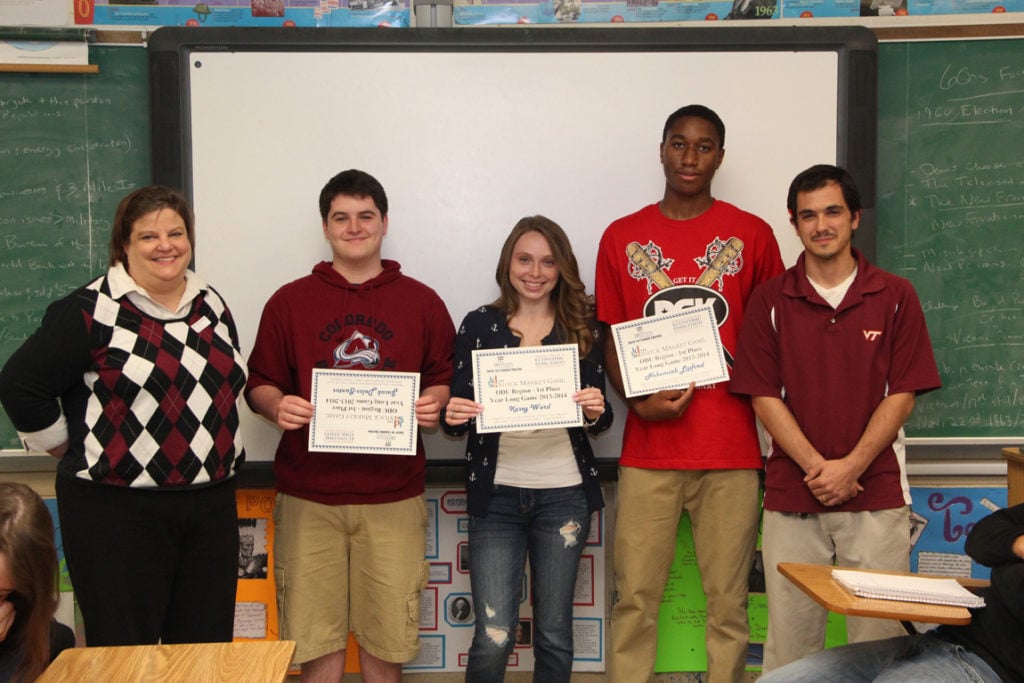
2014 1st Place High School District winners in Stock Market Game. From Left to Right- Ruth Cookson Program Director for Economic Education at Old Dominion University; my students; Me
Lesson Plans World History II SOL 10c: Russian Revolution
Standard WH II: The student will demonstrate knowledge of the worldwide impact of World War I.
Objectives: Citing causes and consequences of the Russian Revolution.
Lesson Plans:
Introduction: A Bell-ringer activity
Notes: Students copy-down and discuss teacher generated notes
Activities: Students complete various in class activities to support learning including video analysis, maps, charts, diagrams, graphic organizers, worksheets, text-book questions, group discussion, KWL Charts etc.
Assessment: Informal, Formal, Exit-Questions, Teacher Questioning. Quizzes, Tests, Projects
Essential Knowledge: Causes of 1917 revolutions
• Defeat in war with Japan in 1905
• Landless peasantry
• Incompetence of Tsar Nicholas II
• Military defeats and high casualties in World War I Rise of communism
• Bolshevik Revolution and civil war
• Vladimir Lenin’s New Economic Policy
• Joseph Stalin, Lenin’s successor
Lesson Plans World History II SOL 9de: Imperialism and the Scramble for Africa, Asia, and India
Standard WH II: The student will demonstrate knowledge of the effects of the Industrial Revolution during the nineteenth century.
Objectives: Explaining the rise of industrial economies and their link to imperialism and nationalism;
Assessing the impact of European economic and military power on Asia and Africa, with emphasis on the competition for resources and the responses of colonized peoples.
Lesson Plans
Introduction: A Bell-ringer activity
Notes: Students copy-down and discuss teacher generated notes
Activities: Students complete various in class activities to support learning including video analysis, maps, charts, diagrams, graphic organizers, worksheets, text-book questions, group discussion, KWL Charts etc.
Assessment: Informal, Formal, Exit-Questions, Teacher Questioning. Quizzes, Tests, Projects
Essential Knowledge:
Nationalism motivated European nations to compete for colonial possessions. European economic, military, and political power forced colonized countries to trade on European terms. Industrially produced goods flooded colonial markets and displaced their traditional industries. Colonized peoples resisted European domination and responded in diverse ways to Western influences. Forms of imperialism
• Colonies
• Protectorates
• Spheres of influence Imperialism in Africa and Asia
• European domination
• European conflicts carried to the colonies
• Christian missionary efforts
• Spheres of influence in China
• Suez Canal
• East India Company’s domination of Indian states
• America’s opening of Japan to trade Responses of colonized peoples
• Armed conflicts (e.g., events leading to the Boxer Rebellion in China)
• Rise of nationalism (e.g., first Indian nationalist party founded in the mid-1800s)
Lesson Plans World History II SOL 9b Capitalism and Communism
Standard WH II: The student will demonstrate knowledge of the effects of the Industrial Revolution during the nineteenth century
Objectives: Explaining the emergence of capitalism as a dominant economic pattern, and the subsequent development of socialism and communism.
Lesson Plans:
Introduction: A Bell-ringer activity
Notes: Students copy-down and discuss teacher generated notes
Activities: Students complete various in class activities to support learning including video analysis, maps, charts, diagrams, graphic organizers, worksheets, text-book questions, group discussion, KWL Charts etc.
Assessment: Informal, Formal, Exit-Questions, Teacher Questioning. Quizzes, Tests, Projects
Essential Knowledge: Capitalism
• Adam Smith’s The Wealth of Nations
• Role of market competition and entrepreneurial abilities
• Impact on standard of living and the growth of the middle class
• Dissatisfaction with poor working conditions and the unequal distribution of wealth in society
Socialism and communism
• Karl Marx’s The Communist Manifesto (written with Friedrich Engels) and Das Kapital
• Response to the injustices of capitalism
• Importance to communists of redistribution of wealth
Lesson Plans World History II SOL 10a: World War One
Standard WH II: The student will demonstrate knowledge of the worldwide impact of World War I.
Objectives: Explaining economic causes, political causes, and major events and identifying major leaders of the war, with emphasis on Woodrow Wilson and Kaiser Wilhelm II.
Lesson Plans
Introduction: A Bell-ringer activity
Notes: Students copy-down and discuss teacher generated notes
Activities: Students complete various in class activities to support learning including video analysis, maps, charts, diagrams, graphic organizers, worksheets, text-book questions, group discussion, KWL Charts etc.
Assessment: Informal, Formal, Exit-Questions, Teacher Questioning. Quizzes, Tests, Projects
Essential Knowledge: Causes of World War I
• Alliances that divided Europe into competing camps
• Nationalistic feelings
• Diplomatic failures
• Imperialism
• Competition over colonies
• Militarism Major events
• Assassination of Austria’s Archduke Ferdinand
• United States enters the war
• Russia leaves the war Major leaders
• Woodrow Wilson
• Kaiser Wilhelm II