Posted on 1 Comment

Conqueror Record Label

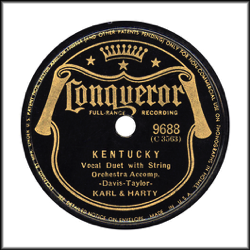
Conqueror Record Label: 1938-1942. Black color with shield.

 Conqueror Record Label

Produced from 1926-March 1942 exclusively for Sears at a price of 39 cents. Designed as an expensive label to complement the Silvertone, Supertone, and Challenge labels. Pressed by Regal Record Company from 1926-June 1929 and then pressed American Record Company (ARC) from 1929 onward. When ARC took over the pressing, they dropped all mention of Sears on the record.

The trumpeters were removed in 1934 and replaced by a simplified shield design. When ARC was bought by CBS in 1938, CBS kept the Conqueror label and packaged the label in sets. In the label’s final days (1938-1942) the Conqueror’s shield appeared as black rather than red. Many of Conqueror’s artists used pseudonyms and because Sears was at various times contracting three different record companies to produce music and those record companies often drew from the same catalogs or master records there is considerable duplication of music. However, some records may be alternate takes, and records produced after the 1938 acquisition tended to be artists from the CBS catalogs.

Music Genres: Country, Jazz, Blues, Swing, Pop.

Pre-WW2 Label: Red background with decorative rim and trumpeters.
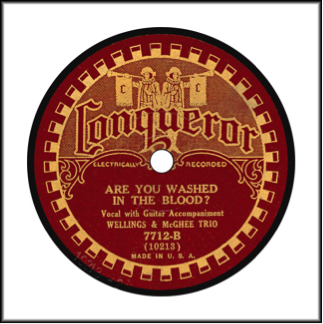
Record Label:  1929-1934. Note the absence of Sears. May be in red or orange.
Conqueror Record Label: 1929-1934. Note the absence of Sears. It may be in red or orange. This indicates it was made by ARC.

From 1934-1938 the record label has a basic red shield without the trumpeters.
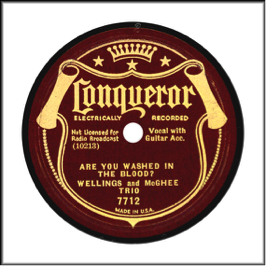
Record Label: 1934-1938. Red color with shield.
Record Label: 1934-1938. Red color with shield. Notice the lack of trumpeters.

1941-1945 Label: After being bought by CBS, the label switched to being all-black.

Conqueror  Record Label: 1938-1942. Black color with shield.
Conqueror Record Label: 1938-1942. The black color with shield.

Post-WW2 Label: None.

Numbers from start to 1945:  7000-10000.  Numbers 7254-7277 are race and country artists.

Notes: Famous artists found on this record label include: Big Bill Broonzy, Lucille Bogan (aka: Bessie Jackson), Amos Easton aka Bumble Bee Slim, Lil Johnson, and Memphis Minnie. Other important artists include Louis Armstrong, Cab Calloway, and Gene Autry.

Listen to Dear Old Western Skies by Gene Autry on a 1934 Conqueror Record.

Listen to My Gage is going up by Memphis Minnie on a Conqueror Record most likely from the early 1930s.

Sources:
http://www.mainspringpress.com/sears-labels.html

Rust, Brian. The American Record Label Book. Arlington House Publishers, NY. 1978.

Sutton, Nauck. American Record Labels and Companies: An Encyclopedia (1891-1943). Mainspring Press, CO.2000.

The Blues Encyclopedia

Country Music Records: A Discography, 1921-1942
Posted on 1 Comment

Challenge Records

Challenge Record Label

 Challenge Records by Sears

The Challenge record label was a budget label for Sears. It was produced from 1926-1930. It was pressed by the Starr Piano Company and would duplicate recordings found on Gennett and Champion records. Most were of anonymous recordings.

The Challenge Label sold for 24 cents and is generally of inferior quality. Starr struggled to produce records and, in its final years, Sears used The Scranton Button Company to press the records using master records from Plaza Music Company.

Music Genres: Waltz, orchestra, race records, blues, country, popular, reprints of Gennett and Champion records.

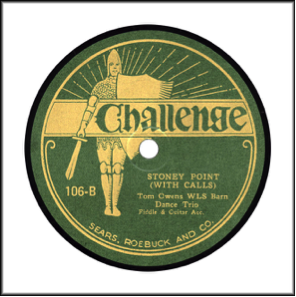
Pre-WW2 Label: This was the only label design for the record production: 1926-1930. Green and Gold with a Knight in Armor imagery. Note: Wikipedia for some reason has the record below but in black and white which is inaccurate.

Challenge Record Label
Challenge Record Label by Sears: 1926-1930

1939-1945 Label: None by Sears

Post-WW2 Label: None by Sears.

Numbers from start to 1945: 101-810
The Challenge Label has an unknown number of recordings but the series consists of 3 digits.

 101–271, 301–431, 501–506 = Gennett

 532–698, 763–793, 811–999 = Plaza and successor American Record Corporation;

 700–760 and 801–810 = Miscellaneous sources

Note: Many of the country artists were pseudonyms.

Sources:

http://www.mainspringpress.com/sears-labels.html

Country Music Records: A Discography, 1921-1942
Posted on 2 Comments

Supertone Records

Supertone (1924; 1928-mid 1931) by Sears

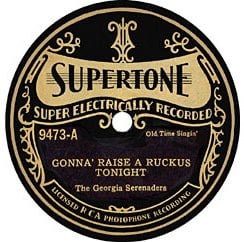
Supertone was a record label made for Sears. It was marketed as a higher-quality label and replaced the Silvertone. Supertone was introduced in 1924 and discontinued in the same year. The 1924 series of Supertones were made by the Fletcher Record Company and are the rarer of the two label designs. Supertone would re-emerge in mid-1928 and last until 1931. From 1928-to 1931 over 800 records were issued. The 1928-1931 labels were black with the words “Super Electrically Recorded” in block letters below the shield. This meant that the recording artist used a microphone to record the sound rather than play it into a horn.

About halfway through the series the reference to Sears, Roebuck, and Co was replaced by the words “Licensed RCA Photophone Recording”. These Supertone labels were pressed by Starr Piano Company until 1931. Many of the Starr-produced recordings were done under artist pseudonyms. In the final year of the Supertone Record label, Sears switched record manufacturers from Starr to Brunswick Radio Corporation. These new Supertones had an S-prefix before the record number. Like the early Fletcher made Supertone records, these Brunswick Supertones are rare too. Supertone Records were discontinued in 1931 by the Great Depression and the desire for Sears to bring back the Silvertone Label.

Music Genres: Band, Waltz, Orchestra, band, jazz, blues, Midwestern dance.

Numbers from start to 1945: 1000-9000

Pre-World War II Label:

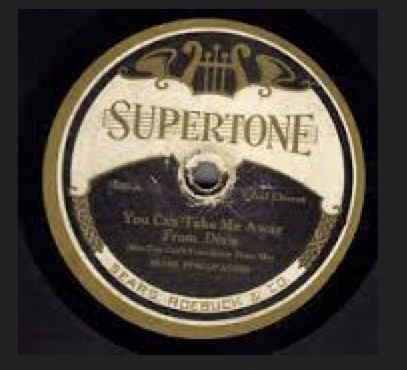
The artist on this label, below, is the Miami Syncopators – You can take me away from Dixie (but you can’t take Dixie from me)  1502-A. The Miami Syncopators were a pseudonym for Harry Reser and his Orchestra.

Record Label: 1924. This label design lasted only one year.
Supertone Record Label: 1924. This label design lasted only one year. A white, gold, and black design. Note the Sears phrase at the bottom.

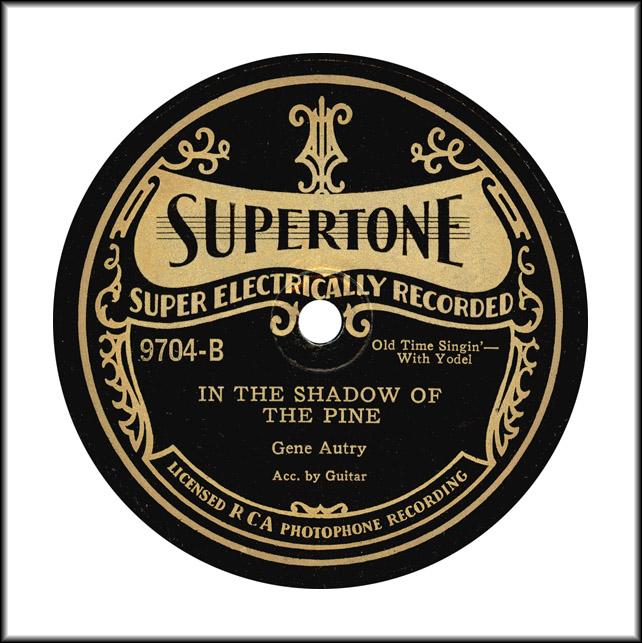
The artist below is Gene Autry (as known as the Singing Cowboy)  In the Shadow of the Pine 9704-B.

Supertone Record gene-autry
Supertone Record Label 1928-1931. Produced by Starr Piano Company. Note the” Licensed RCA Photophone Recording” phrase at the bottom. A gold and black design.

Sometimes this song is referred to as In the Shadow of the Old Pine Tree:

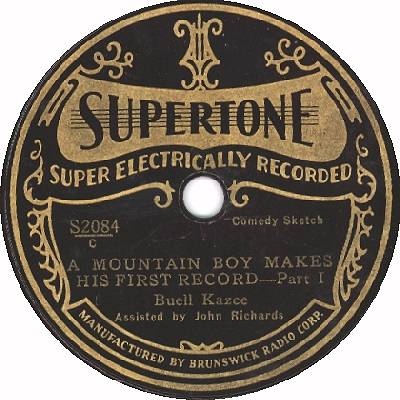
The final Supertone Label is an artist called Buell Kazee, A Mountain Boy Makes his First Record-Part 1 S-2084.

Supertone Record Label by Brunswick Radio. Produced in mid-1931.
Supertone Record Label by Brunswick Radio Corporation. Produced in mid-1931. Note the “S” prefix and the Brunswick Radio Corp phrase at the bottom.

You can listen to the song by clicking the link below:

Buell H. Kazee A Mountain Boy makes his First Record-Part 1

Sources:
-Rust, Brian. The American Record Label Book. Arlington House Publishers, NY. 1978.
-Sutton, Nauck. American Record Labels and Companies: An Encyclopedia (1891-1943).Mainspring Press, CO.2000.
http://www.mainspringpress.com/sears-labels.html

Posted on 1 Comment

Silvertone Records

Silvertone 1916

Silvertone Record Label (1916-1950) by Sears

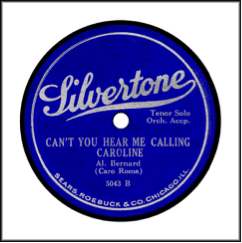
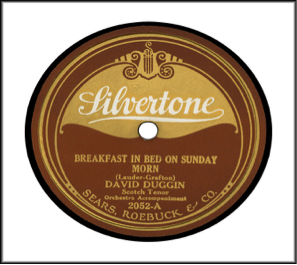
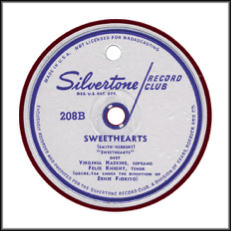
Silvertone records would replace the Oxford line of records in 1916. These early Silvertone records had an orange background and were produced and pressed by Columbia Records. In 1917, Silvertone changed the label background to purple with block lettering. However, one year later, in 1918 Sears would discontinue the Silvertone line. Though, it would re-emerge in 1919 with a new silver and blue label. These labels were produced and pressed by Federal Records. After a fire at the plant, Sears would create a new tan label in the early/mid-1920s and used many suppliers including Columbia, Starr, Brunswick, Emerson, and Pathe. These tan labels contain rare anonymous recordings.

Silvertone would be discontinued again in mid-1928. Sears would eventually replace the Silvertone label with a Supertone label (produced and pressed by Starr Piano Company) in the 1930s. Silvertone would re-emerge as a label for Sears in 1940 and be discontinued one year later, in 1941. The 1940-1941 Silvertone was produced and pressed by Columbia Record Corporation. Silvertone would come back one last time in 1950. These were red Vinylite pressings produced, this time, by Mercury Records. Sears would go on to produce the Challenge budget record label from 1926-to 1930 and a more expensive line called Conqueror from 1928-to 1942.

Most of the records made for Sears were duplicate recordings, reprints of existing catalog numbers, or anonymous recordings. Some of the records produced for Sears under the Silvertone label were alternate recordings. These are especially rare and valuable.

Music Genres: Band, Waltz, Orchestra, Band, Jazz, Blues.

Pre-1941 Labels: Orange, purple, tan, or blue in color. Silvertone in block or scripted lettering. An image of a piper with a two-person audience or just the piper appeared on pre-1920 labels.

Silvertone 1916
Silvertone 1916. Orange background. Made by Columbia Records.

While not on the Silvertone label: When the Lusitania Went Down, 1915 of which the lyrics can be seen at that link.

Silvertone Record Label Late 1917
Silvertone Record Label late 1917. Purple with gold lettering.  Made by Columbia Records
Silvertone mid 1920s
Silvertone’s blue and scripted lettering label. Produced by Federal from 1918/1919-1924
Silvertone mid 1920s
Silvertone’s Tan Label. Made in 1923 or 1924. Made by a variety of different manufacturers.

World War II Label: Scripted lettering and blue background with the piper image replaced with an SR (Sears and Roebuck) logo at the top.

Silvertone1940-1941
Silvertone 1940-1941. Brought back by Sears. Mainly produced by Columbia.

Post World War II Label: Scripted blue lettering on a white background.

Silvertone Post-WW2 1950
Silvertone Post-WW2 1950. Produced by Mercury for Sears on red vinyl.

As an example of what the post-WW2 Silvertone sounds like: Stardust by Glenn Osser in 1950.

Numbers from start to 1945: #200-25000.

Sources:

http://www.mainspringpress.com/sears-labels.html

Rust, Brian. The American Record Label Book. Arlington House Publishers, NY. 1978.

Sutton, Nauck. American Record Labels and Companies: An Encyclopedia (1891-1943). Mainspring Press, CO.2000.

Posted on 1 Comment

Oxford Record Label

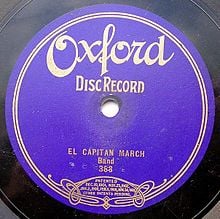
1906 El Capitan March. 7in. disc. Probably made by Columbia

Oxford Record Label (1906-1916)

The Oxford Record Label was a Sears label that came after Sears’ discontinuation of their Harvard Label. They are single-sided and can be found as either a 7in. disc or a 10in. disc.  At the start, Sears used Leeds and Catlin from 1906-1908 to produce the record, switched to Columbia from 1908-1909, then to Victor (using their Zon-o-phone masters) between 1909-1911, and then back to Columbia between 1911-1916. Indeed, Columbia continued to produce for Sears under the Oxford label a 7in. disc while Victor produced a 10in. disc. Recordings are mostly anonymous For an excellent review of the Oxford label see the sources below.

Music Genres: Waltz, Black or “Coon” music, Orchestra, Marches, Operettas.

Pre World War II Label: Purple with Oxford in a scripted style.

1906 El Capitan March. 7in. disc. Probably made by Columbia
1906 El Capitan March by Soussa. 7in. disc. Probably made by Columbia.
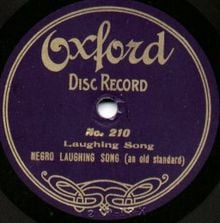
1908 Negro Laughing Song. Probably made by Victor using Zonophone masters.
1908 Negro Laughing Song by George W. Johnson. Probably made by Victor using Zonophone masters.

While not an Oxford Label it is an example of the Negro Laughing Song by George W. Johnson who was the first African-American to sing on a record.

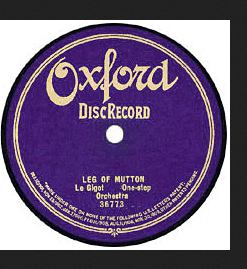
Leg of Mutton Oxford Record label 36773
Leg of Mutton Le Gigot. 12in. Oxford Record Label #36773. Probably made by Columbia in the early 1910s.

 Leg of Mutton Le Gigot, 1913.

Numbers to 1945: Columbia will switch to a new label called Silvertone in 1915/1916.

1-1000 (by Columbia, Zonophone)1000-2000 (by Columbia, Zonophone)
3000 – 5000 (by Columbia)        5000 (by Zonophone)

Sources:
http://www.mainspringpress.com/sears-labels.html

Posted on 1 Comment

Harvard Record Labels

Harvard Record Labels (1905-1907)

Harvard Records was a 78 record label sold exclusively by Sears. Columbia Records originally produced the record. The catalog numbers were similar to Columbia master catalogs. The Harvard Record Label used anonymous recordings. The records came in either 7in. or 10in. sizes.

Music Genres: Waltz, Patriotic, Orchestra, Comedic, Folk Songs, Black or “Coon” songs. (The Harvard Record label and Sears sold music that exemplified the time. Such musical lyrics that stereotyped dialects would be unacceptable today)

Pre-1941 Label: Plan label with blue lettering.

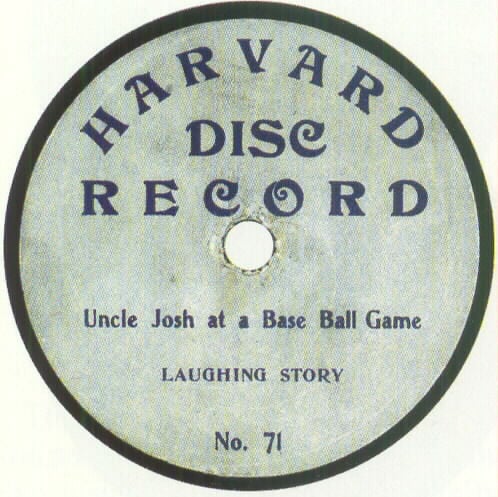
Harvard Disc Record. Courtesy of http://www.78rpm.net.nz

Uncle Josh was the pseudonym for Cal Stewart, a vaudeville actor that made the transition into sound. He is known for comedic narratives. While not on a Harvard Disc the recording below is indicative of Cal’s comedic style.

Another example of the early Harvard Disc Record label.

I Never Trouble Trouble until Trouble Troubles Me
I Never Trouble Trouble Until Trouble Troubles Me by Baritone and Tenor Duet

Not on a Harvard Record label but it demonstrates what the duet sounded like. You can note the same catalog number as the Harvard disc above. This was due to the fact that Harvard pulled from the master catalog of Columbia. Indeed, it appears the Peerless Disc Record did as well.


The Harvard Record label went through a label re-design in late 1906 or early 1907. This new design featured a collegiate pennant and lettering in orange.

World War Two Label: None. The label did not exist

Sources:

http://www.mainspringpress.com/sears-labels.html

Posted on

Montgomery Ward Records

Montgomery Ward Records (1933-1941)

Sold through Montgomery Ward’s catalog. Contracted pressing of records and licensing to Decca, RCA, Columbia, Victor, Bluebird, and others. These records could be found in their stores or in their catalogs.

Music Genres: Country, Pop, Blues, Western, Mexican, Swing.

1933-1941: Record Label

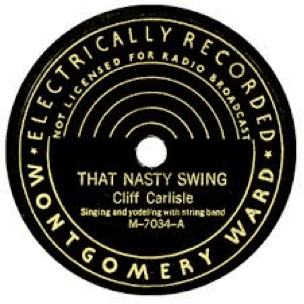
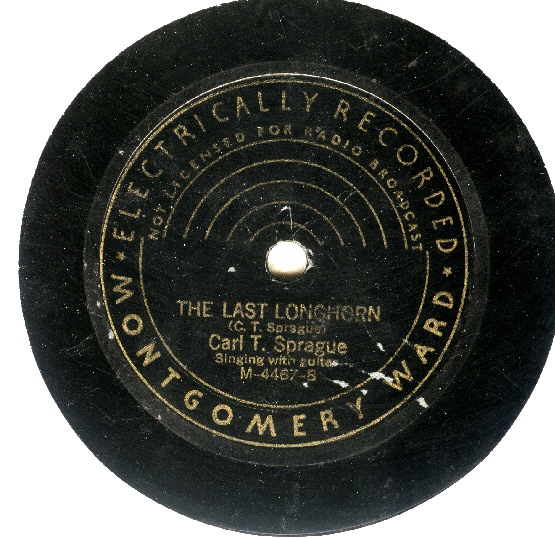
Record Label: Pre-WW2. Black or dark blue coloring always with gold. Note the design of semi-circles.
Montgomery Ward Record Label: Pre-WW2. Black or dark blue coloring always with gold. Note the design of semi-circles.
Produced in 1934
Montgomery Ward Record:  Produced in 1934

Cartwright Brothers on Montgomery Ward.

1941-1945s Label: None

Post-WW2 Label: None

Numbers from start to 1945: 1000-10173

Notes: 6000 is their light classical series.

Sources:

Catalog Listing: http://www.78discography.com/

Rust, Brian. The American Record Label Book. Arlington House Publishers, NY. 1978.

Sutton, Nauck. American Record Labels and Companies: An Encyclopedia (1891-1943).Mainspring Press, CO.2000.

Music Genres: Country, Pop, Blues, Western, Mexican, Swing

Posted on

Capitol Records

Capitol Records WW2

Capitol Records (1942-present)

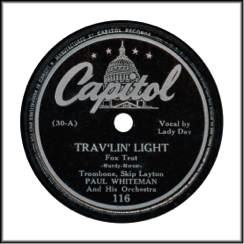
Founded by Johnny Mercer in 1942 and Buddy DeSylva. Capitol Records would go on to buy the Scranton,PA Record Company (formerly known as the Scranton Button Company Plant) in 1946. The Scranton Record Company has its unique history of strikes and Beatlemania as well as a wonderful Facebook page that documents it all.

Capitol Records would introduce LPs and 45s in the late 1940s. Capitol would be bought by Electrical and Musical Instruments (EMI) a European conglomerate in 1956.

Continue reading Capitol Records
Posted on

Velvet Tone Records

Velvet Tone Record

Velvet Tone Records (1925-1932)

Velvet Tone was introduced in 1925 by Columbia as a budget label. It was discontinued in 1932. The label recorded 1,500 records and focused mainly on pseudonymous performances by Columbia stars and miscellaneous free-lance musicians. The exception was that in 1930 a 7000 series was introduced devoted to blues and race items. The label relied on acoustic recordings rather than the newer technology of electrical recordings.

Velvet Tone Record
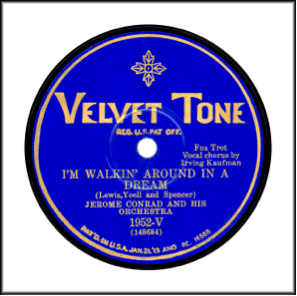
Record Label: 1925-1932 Velvet Tone with a four-point star and in bright blue and gold coloring.

Sources
http://www.columbiarecords.com/timeline/#!date=1893-09-14_09:55:12!
http://lp-originales.info/documents/online_editable_page_1.php
–Rust, Brian. The American Record Label Book. Arlington House Publishers, NY. 1978.
–Sutton, Nauck. American Record Labels and Companies: An Encyclopedia (1891-1943). Mainspring Press, CO.2000.

Posted on

Harmony Records

Harmony Red and Gold

Harmony Records (1925-1932)

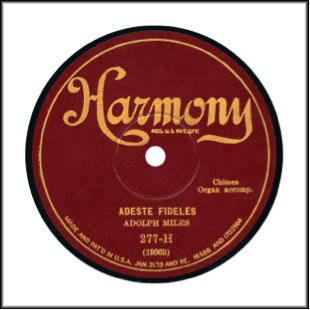
Columbia introduced Harmony as a budget label in Sept. 1925. It was discontinued in June 1932. Between 1925 and 1932, Harmony focused mainly on pseudonymous performances by Columbia stars. Harmony was priced at 50 cents mainly because the Harmony label did not record in the electrical recording technology. In the summer of 1949, CBS will revive the Harmony label in a puce color but will discontinue it by early 1950 after only about 100 reissues of Columbia material. By mid-1957 CBS will introduce a new redesigned Harmony label in a 45 format and LP format.

Continue reading Harmony Records