The Challenge record label was a budget label for Sears. It was produced from 1926-1930. It was pressed by the Starr Piano Company and would duplicate recordings found on Gennett and Champion records. Most were of anonymous recordings.
The Challenge Label sold for 24 cents and is generally of inferior quality. Starr struggled to produce records and, in its final years, Sears used The Scranton Button Company to press the records using master records from Plaza Music Company.
Music Genres: Waltz, orchestra, race records, blues, country, popular, reprints of Gennett and Champion records.
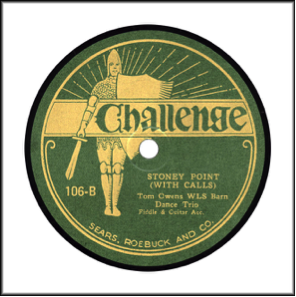
Pre-WW2 Label: This was the only label design for the record production: 1926-1930. Green and Gold with a Knight in Armor imagery. Note: Wikipedia for some reason has the record below but in black and white which is inaccurate.
Challenge Record Label by Sears: 1926-1930
1939-1945 Label: None by Sears
Post-WW2 Label: None by Sears.
Numbers from start to 1945: 101-810 The Challenge Label has an unknown number of recordings but the series consists of 3 digits.
101–271, 301–431, 501–506 = Gennett
532–698, 763–793, 811–999 = Plaza and successor American Record Corporation;
700–760 and 801–810 = Miscellaneous sources
Note: Many of the country artists were pseudonyms.
The Stock Market Game is reserved for my Senior Government classes. They do not have a state-test to take and it is easier to plan the time it takes to set-up and play. The Stock Market Game has a cost associated with it. For the past five years I have always found the money by applying for various grants particularly through Bayport Credit Union: Bayport Credit Union Grant.
To set-up the Stock Market Game I plan a curriculum that teaches students the basics of the game, how to read financial information, how to compare stocks, and how to search for stocks.
1. Stock Market Game Introduction Activities
The first activity is an outline of key vocabulary terms, what the stock market is etc. I also explain to students WHY we are doing this and how to win. I use a KWL Chart, notes, reading, and videos:
KWL Chart: Students create a 3-column sheet. The Topic is the Stock Market. Students fill in what they know and what they want to know about it. They will fill in the “L” column with what they learned about the Stock Market after the game is over.
Stock Market Video(Youtube) and Stock Market Video Questions : I’ve tried finding various stock market videos that give a good generally outline of how it works. The best I have found is from the 1950s/1960s which, as reflective of the times, comes across as sexist and lacks diversity. I’ve included it but if someone knows of a better video please let me know.
2. Quiz:
After the introduction is complete I normally give the students a quiz over the information. Either I make the quiz-up or I use a quiz given by the Stock Market Game. Note: These quizzes may be out of date.
3. Stock Market Game Skills: The next activities involve learning how to read stock information and how to search for it. I encourage students to use NYSE , NASADAQ ,or Google Finance to search for stock market information.
Jim’s Birthday Present Activity : I use this as a review of the above information. They brainstorm companies in bold. These will be used later on.
How to Interpret Stock Data from Internet: A handout with important stock terms. Students read the terms, discuss the terms and then fill in an example below using the stocks they brainstormed. Note: You may need to make modifications of this handout to reflect what is actually displayed on the stock page.
Stock Market Newspaper and Internet Analysis : A handout that walks students how to read financial information on a newspaper and on the internet. They should focus on the stocks they brainedstormed. Note: You may need to make modifications of this handout to reflect what is actually displayed on the stock page.
4. Stock Market Game Skill Practice:
When students are finished analyzing stocks. I give them their research sheets. Student’s will be divided into teams and will need to take on different roles. In these activities students are to practice their roles. They complete worksheets using the stocks the brainstormed. Depending on how much time you have you can assign all of them, combine them together, or assign a couple on each page. When students are done you could discuss which stocks they think will go up or down depending on their data.
Sector Industry Worksheet : This worksheet can be done at the end of class or at the start of next class. It will introduce students to sector industries. Students can place their brainstormed stocks in the right sector and then conduct research and add additional stocks into the different sectors.
5a. Assigning Teams and Picking a Stock Market Game Name:
The final part before the game begins is to have students select their team name and assign roles of: Director, Technical, and Basic. If the group has 4 students I usually give another technical research sheet. I inform students that roles will rotate every two weeks.
I normally assign students into teams of 3-4 individuals. Each class usually has about 8 teams. Each team gets a folder. Taped to the inside of the folder are their names and their team’s Stock Market Game password. Inside that folder is the following:
5c. Logo Creation: Once they have their name and I have approved it they create a logo and write their names on their folder.
5d: Consensus Chart
Upon completion of their name and logo I have each person in the group complete a consensus chart. Student’s grade each other using the following rubric.
4 person consensus chart : Rubric for students to grade each other.
6: Running the Stock Market Game and Grading
I usually run the stock market game in my class during school hours. I teach for about half the period and then let the students play the game. I try for having the students play the game at least twice a week. I do not get involved in what they are investing in. I let the students succeed or fail on their own. After all this is a learning activity. I aim to have students work on their stocks either on Monday or Friday of the week.
Grading: Their Stock Market Game grade is based on students grading themselves using the Consensus Sheet. I take an average of the grades. I also assign them an individual participation grade as well.
Sometimes I play Bloomberg Business while they are working. I also allow students to use their phones as students will download Stock Market Apps.
7. Other Activities
Warren Buffet Lesson Plan: A brief mini lesson plan on Warren Buffet. Student’s are introduced to Warren Buffet and why he is important. Student’s are encourage to try to invest in one of his companies OR a company he has invested in.
Investwrite: Students write an essay in response to an investment topic. These are competitive with awards and prizes given.
I also have students do research on a company they would like to work for. They present their findings to the class.
At the end of the game, students complete the “Learn” part of their KWL chart. Student’s also write an essay (2-5 paragraphs) on what they learned. Alternatively, you could have them respond to the Invest Write essay without actually submitting it in.
10. Pictures
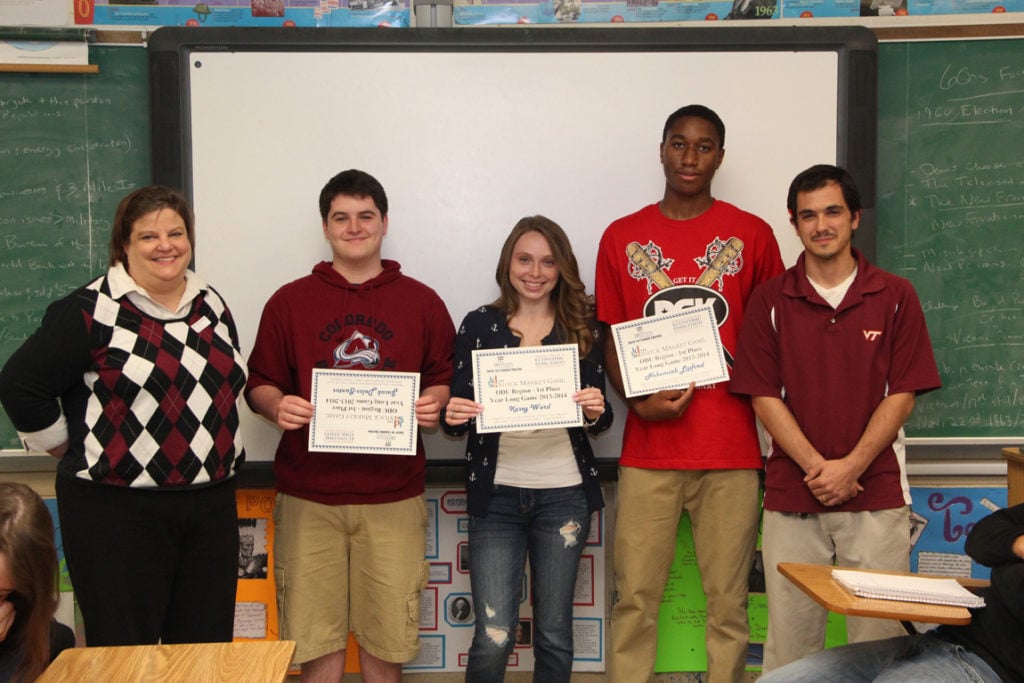
2014 1st Place High School District winners in Stock Market Game. From Left to Right- Ruth Cookson Program Director for Economic Education at Old Dominion University; my students; Me
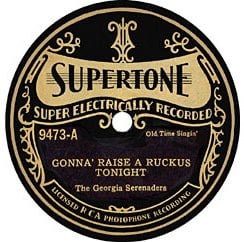
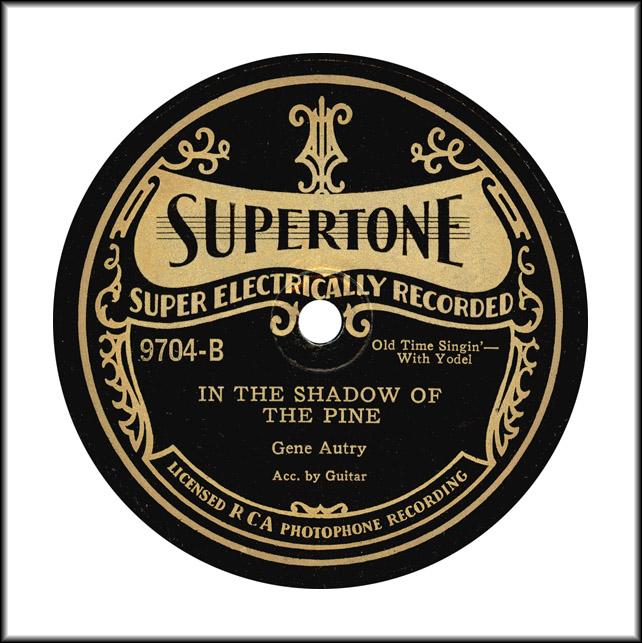
Supertone was a record label made for Sears. It was marketed as a higher-quality label and replaced the Silvertone. Supertone was introduced in 1924 and discontinued in the same year. The 1924 series of Supertones were made by the Fletcher Record Company and are the rarer of the two label designs. Supertone would re-emerge in mid-1928 and last until 1931. From 1928-to 1931 over 800 records were issued. The 1928-1931 labels were black with the words “Super Electrically Recorded” in block letters below the shield. This meant that the recording artist used a microphone to record the sound rather than play it into a horn.
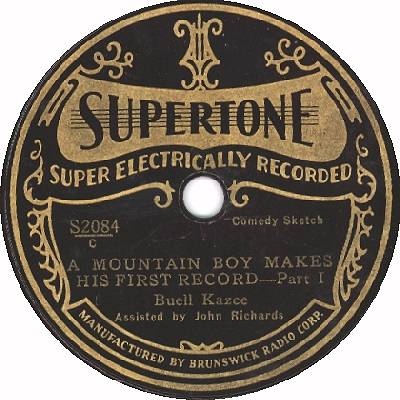
About halfway through the series the reference to Sears, Roebuck, and Co was replaced by the words “Licensed RCA Photophone Recording”. These Supertone labels were pressed by Starr Piano Company until 1931. Many of the Starr-produced recordings were done under artist pseudonyms. In the final year of the Supertone Record label, Sears switched record manufacturers from Starr to Brunswick Radio Corporation. These new Supertones had an S-prefix before the record number. Like the early Fletcher made Supertone records, these Brunswick Supertones are rare too. Supertone Records were discontinued in 1931 by the Great Depression and the desire for Sears to bring back the Silvertone Label.
Music Genres: Band, Waltz, Orchestra, band, jazz, blues, Midwestern dance.
Numbers from start to 1945: 1000-9000
Pre-World War II Label:
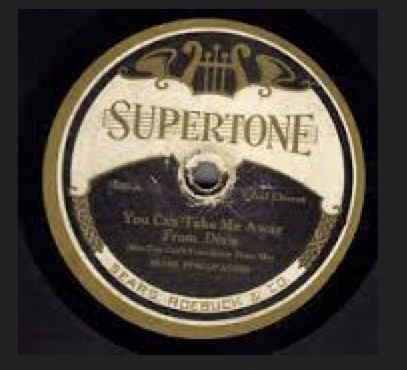
The artist on this label, below, is the Miami Syncopators – You can take me away from Dixie (but you can’t take Dixie from me) 1502-A. The Miami Syncopators were a pseudonym for Harry Reser and his Orchestra.
Supertone Record Label: 1924. This label design lasted only one year. A white, gold, and black design. Note the Sears phrase at the bottom.
The artist below is Gene Autry (as known as the Singing Cowboy) In the Shadow of the Pine 9704-B.
Supertone Record Label 1928-1931. Produced by Starr Piano Company. Note the” Licensed RCA Photophone Recording” phrase at the bottom. A gold and black design.
Sometimes this song is referred to as In the Shadow of the Old Pine Tree:
The final Supertone Label is an artist called Buell Kazee, A Mountain Boy Makes his First Record-Part 1 S-2084.
Supertone Record Label by Brunswick Radio Corporation. Produced in mid-1931. Note the “S” prefix and the Brunswick Radio Corp phrase at the bottom.
You can listen to the song by clicking the link below:
Sources: -Rust, Brian. The American Record Label Book. Arlington House Publishers, NY. 1978. -Sutton, Nauck. American Record Labels and Companies: An Encyclopedia (1891-1943).Mainspring Press, CO.2000. –http://www.mainspringpress.com/sears-labels.html
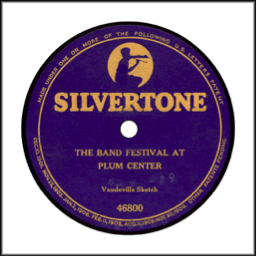
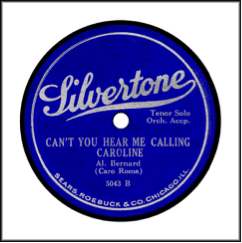
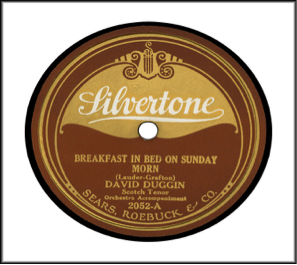
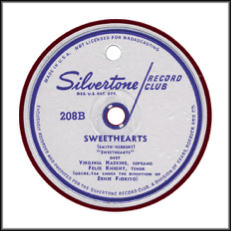
Silvertone records would replace the Oxford line of records in 1916. These early Silvertone records had an orange background and were produced and pressed by Columbia Records. In 1917, Silvertone changed the label background to purple with block lettering. However, one year later, in 1918 Sears would discontinue the Silvertone line. Though, it would re-emerge in 1919 with a new silver and blue label. These labels were produced and pressed by Federal Records. After a fire at the plant, Sears would create a new tan label in the early/mid-1920s and used many suppliers including Columbia, Starr, Brunswick, Emerson, and Pathe. These tan labels contain rare anonymous recordings.
Silvertone would be discontinued again in mid-1928. Sears would eventually replace the Silvertone label with a Supertone label (produced and pressed by Starr Piano Company) in the 1930s. Silvertone would re-emerge as a label for Sears in 1940 and be discontinued one year later, in 1941. The 1940-1941 Silvertone was produced and pressed by Columbia Record Corporation. Silvertone would come back one last time in 1950. These were red Vinylite pressings produced, this time, by Mercury Records. Sears would go on to produce the Challenge budget record label from 1926-to 1930 and a more expensive line called Conqueror from 1928-to 1942.
Most of the records made for Sears were duplicate recordings, reprints of existing catalog numbers, or anonymous recordings. Some of the records produced for Sears under the Silvertone label were alternate recordings. These are especially rare and valuable.
Music Genres: Band, Waltz, Orchestra, Band, Jazz, Blues.
Pre-1941 Labels: Orange, purple, tan, or blue in color. Silvertone in block or scripted lettering. An image of a piper with a two-person audience or just the piper appeared on pre-1920 labels.
Silvertone 1916. Orange background. Made by Columbia Records.
While not on the Silvertone label: When the Lusitania Went Down, 1915 of which the lyrics can be seen at that link.
Silvertone Record Label late 1917. Purple with gold lettering. Made by Columbia Records
Silvertone’s blue and scripted lettering label. Produced by Federal from 1918/1919-1924
Silvertone’s Tan Label. Made in 1923 or 1924. Made by a variety of different manufacturers.
World War II Label: Scripted lettering and blue background with the piper image replaced with an SR (Sears and Roebuck) logo at the top.
Silvertone 1940-1941. Brought back by Sears. Mainly produced by Columbia.
Post World War II Label: Scripted blue lettering on a white background.
Silvertone Post-WW2 1950. Produced by Mercury for Sears on red vinyl.
As an example of what the post-WW2 Silvertone sounds like: Stardust by Glenn Osser in 1950.
The Oxford Record Label was a Sears label that came after Sears’ discontinuation of their Harvard Label. They are single-sided and can be found as either a 7in. disc or a 10in. disc. At the start, Sears used Leeds and Catlin from 1906-1908 to produce the record, switched to Columbia from 1908-1909, then to Victor (using their Zon-o-phone masters) between 1909-1911, and then back to Columbia between 1911-1916. Indeed, Columbia continued to produce for Sears under the Oxford label a 7in. disc while Victor produced a 10in. disc. Recordings are mostly anonymous For an excellent review of the Oxford label see the sources below.
Music Genres: Waltz, Black or “Coon” music, Orchestra, Marches, Operettas.
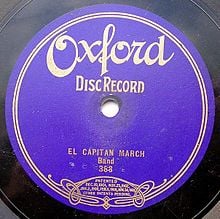
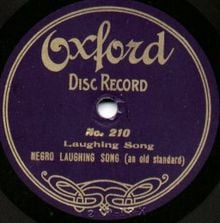
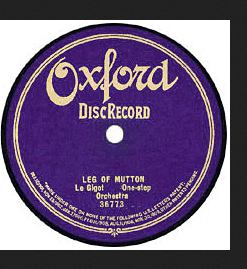
Pre World War II Label: Purple with Oxford in a scripted style.
1906 El Capitan March by Soussa. 7in. disc. Probably made by Columbia.
1908 Negro Laughing Song by George W. Johnson. Probably made by Victor using Zonophone masters.
While not an Oxford Label it is an example of the Negro Laughing Song by George W. Johnson who was the first African-American to sing on a record.
Leg of Mutton Le Gigot. 12in. Oxford Record Label #36773. Probably made by Columbia in the early 1910s.
Leg of Mutton Le Gigot, 1913.
Numbers to 1945: Columbia will switch to a new label called Silvertone in 1915/1916.
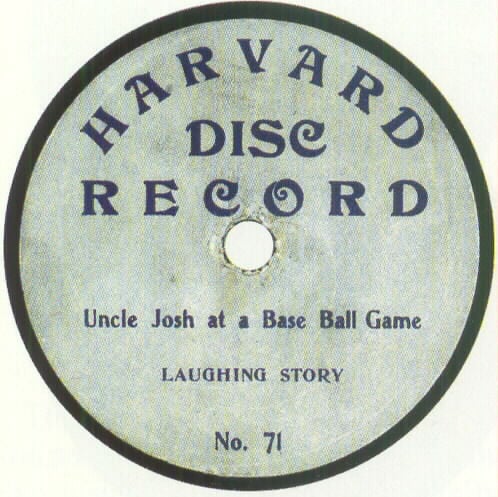
Harvard Records was a 78 record label sold exclusively by Sears. Columbia Records originally produced the record. The catalog numbers were similar to Columbia master catalogs. The Harvard Record Label used anonymous recordings. The records came in either 7in. or 10in. sizes.
Music Genres: Waltz, Patriotic, Orchestra, Comedic, Folk Songs, Black or “Coon” songs. (The Harvard Record label and Sears sold music that exemplified the time. Such musical lyrics that stereotyped dialects would be unacceptable today)
Uncle Josh was the pseudonym for Cal Stewart, a vaudeville actor that made the transition into sound. He is known for comedic narratives. While not on a Harvard Disc the recording below is indicative of Cal’s comedic style.
Another example of the early Harvard Disc Record label.
I Never Trouble Trouble Until Trouble Troubles Me by Baritone and Tenor Duet
Not on a Harvard Record label but it demonstrates what the duet sounded like. You can note the same catalog number as the Harvard disc above. This was due to the fact that Harvard pulled from the master catalog of Columbia. Indeed, it appears the Peerless Disc Record did as well.
The Harvard Record label went through a label re-design in late 1906 or early 1907. This new design featured a collegiate pennant and lettering in orange.
World War Two Label: None. The label did not exist
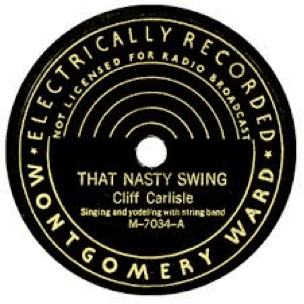
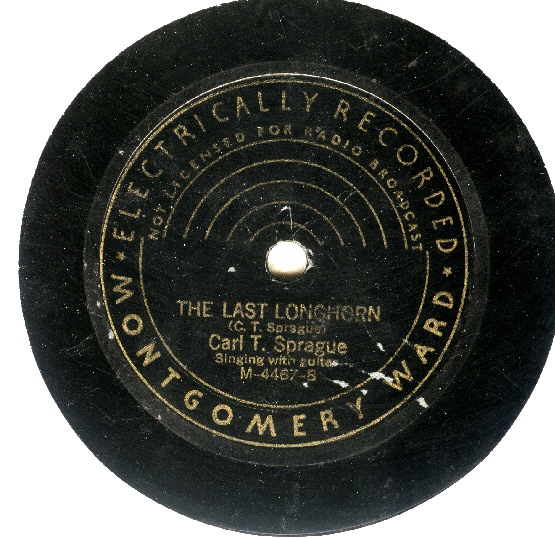
Sold through Montgomery Ward’s catalog. Contracted pressing of records and licensing to Decca, RCA, Columbia, Victor, Bluebird, and others. These records could be found in their stores or in their catalogs.
Music Genres: Country, Pop, Blues, Western, Mexican, Swing.
1933-1941: Record Label
Montgomery Ward Record Label: Pre-WW2. Black or dark blue coloring always with gold. Note the design of semi-circles.
Lesson Plans World History II SOL 10c: Russian Revolution
Standard WH II: The student will demonstrate knowledge of the worldwide impact of World War I.
Objectives: Citing causes and consequences of the Russian Revolution.
Lesson Plans:
Introduction: A Bell-ringer activity
Notes: Students copy-down and discuss teacher generated notes
Activities: Students complete various in class activities to support learning including video analysis, maps, charts, diagrams, graphic organizers, worksheets, text-book questions, group discussion, KWL Charts etc.
Assessment: Informal, Formal, Exit-Questions, Teacher Questioning. Quizzes, Tests, Projects
Essential Knowledge: Causes of 1917 revolutions
• Defeat in war with Japan in 1905
• Landless peasantry
• Incompetence of Tsar Nicholas II
• Military defeats and high casualties in World War I Rise of communism
• Bolshevik Revolution and civil war
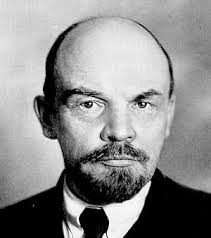
• Vladimir Lenin’s New Economic Policy
• Joseph Stalin, Lenin’s successor
Lesson Plans World History II SOL 9de: Imperialism and the Scramble for Africa, Asia, and India
Standard WH II: The student will demonstrate knowledge of the effects of the Industrial Revolution during the nineteenth century.
Objectives: Explaining the rise of industrial economies and their link to imperialism and nationalism;
Assessing the impact of European economic and military power on Asia and Africa, with emphasis on the competition for resources and the responses of colonized peoples.
Lesson Plans
Introduction: A Bell-ringer activity
Notes: Students copy-down and discuss teacher generated notes
Activities: Students complete various in class activities to support learning including video analysis, maps, charts, diagrams, graphic organizers, worksheets, text-book questions, group discussion, KWL Charts etc.
Assessment: Informal, Formal, Exit-Questions, Teacher Questioning. Quizzes, Tests, Projects
Essential Knowledge:
Nationalism motivated European nations to compete for colonial possessions. European economic, military, and political power forced colonized countries to trade on European terms. Industrially produced goods flooded colonial markets and displaced their traditional industries. Colonized peoples resisted European domination and responded in diverse ways to Western influences. Forms of imperialism
• Colonies
• Protectorates
• Spheres of influence Imperialism in Africa and Asia
• European domination
• European conflicts carried to the colonies
• Christian missionary efforts
• Spheres of influence in China
• Suez Canal
• East India Company’s domination of Indian states
• America’s opening of Japan to trade Responses of colonized peoples
• Armed conflicts (e.g., events leading to the Boxer Rebellion in China)
• Rise of nationalism (e.g., first Indian nationalist party founded in the mid-1800s)
Lesson Plans World History II SOL 9b Capitalism and Communism
Standard WH II: The student will demonstrate knowledge of the effects of the Industrial Revolution during the nineteenth century
Objectives: Explaining the emergence of capitalism as a dominant economic pattern, and the subsequent development of socialism and communism.
Lesson Plans:
Introduction: A Bell-ringer activity
Notes: Students copy-down and discuss teacher generated notes
Activities: Students complete various in class activities to support learning including video analysis, maps, charts, diagrams, graphic organizers, worksheets, text-book questions, group discussion, KWL Charts etc.
Assessment: Informal, Formal, Exit-Questions, Teacher Questioning. Quizzes, Tests, Projects
Essential Knowledge: Capitalism
• Adam Smith’s The Wealth of Nations
• Role of market competition and entrepreneurial abilities
• Impact on standard of living and the growth of the middle class
• Dissatisfaction with poor working conditions and the unequal distribution of wealth in society
Socialism and communism
• Karl Marx’s The Communist Manifesto (written with Friedrich Engels) and Das Kapital
• Response to the injustices of capitalism
• Importance to communists of redistribution of wealth