Lesson Plans World History II 13a: Beginning of the Cold War
Standard WH II: The student will demonstrate knowledge of major events in the second half of the twentieth century by
Objectives: Explaining key events of the Cold War, including the competition between the American and Soviet economic and political systems and the causes of the collapse of communism in the Soviet Union and Eastern Europe.
Note: I tend to break SOL 13a into two parts. One part is on the causes of the Cold War. The other is on the causes of the Cold War ending.
Lesson Plans
Introduction: A Bell-ringer activity
Notes: Students copy-down and discuss teacher generated notes
Activities: Students complete various in class activities to support learning including video analysis, maps, charts, diagrams, graphic organizers, worksheets, text-book questions, group discussion, KWL Charts etc.
Assessment: Informal, Formal, Exit-Questions, Teacher Questioning. Quizzes, Tests, Projects.
Essential Knowledge:
Beginning of the Cold War (1945– 1948)
• The Yalta Conference and the Soviet control of Eastern Europe
• Rivalry between the United States and the U.S.S.R.
• Democracy and the free enterprise system vs. dictatorship and communism
• President Truman and the Policy of Containment
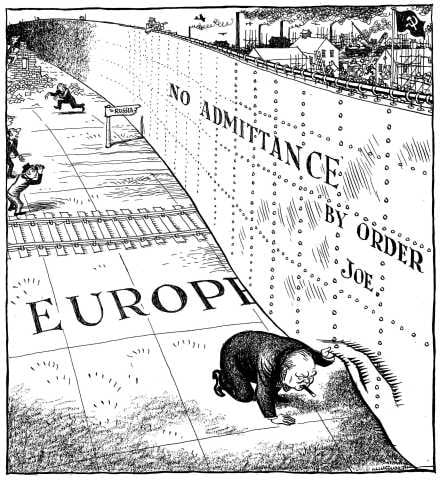
• Eastern Europe: Soviet satellite nations, the Iron Curtain
What Caused the Cold War Inquiry Method: A set of 12 documents. I normally assign students to a group and then using a carousal format, rotate around the room stopping at each station and completing the questions.
Founded by Brunswick-Balke-Collender Company in 1916. In 1924, Brunswick dropped a multi-colored label in favor of a simple black and gold coloring scheme with a shield. In the same year, Brunswick would introduce the Hall of Fame series. The Hall of Fame series would be produced from 1924-1935.
Brunswick would buy the Vocalion label in 1924. By 1928, they dropped the “A” – “B” side designations in favor of underlining the preferred side. In 1930, Brunswick Records were sold to Warner Bros. Warner Bros became a wholly-owned subsidiary of Warner Bros Pictures.
Warner Bros. leased Brunswick to ARC in 1931. Records between 1930-1938 would carry a statement that they were “Manufactured in the USA by Brunswick Radio Corp.”. To get more precise, records produced between 1930-1932 said “Brunswick Radio Corporation” on the labels, and between 1932-1940 “Brunswick Record Corporation” is seen.
American Record Company was bought by Columbia Broadcasting System in Dec. 1938. Brunswick would introduce the Melotone budget label in 1930 and CBS would discontinue it in May 1938. CBS would discontinue the Brunswick label in April 1940. This violated the lease agreement and resulted in Brunswick being transferred to back to Warner Bros. Pictures. Decca would by the label in May 1941.
In 1943Decca revived Brunswick mostly to reissue past recordings primarily from the 80,000 series as a Collector’s Series (mostly blues and jazz from the 1920s/1930s).
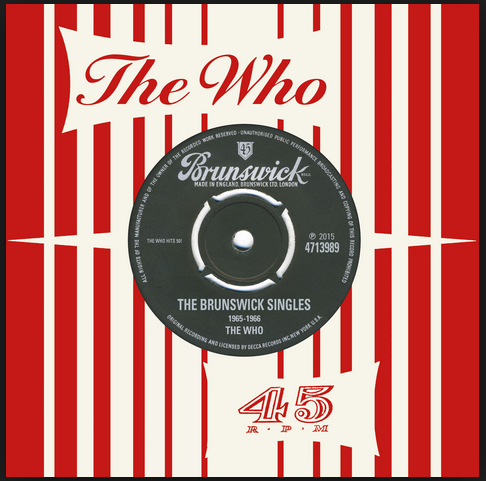
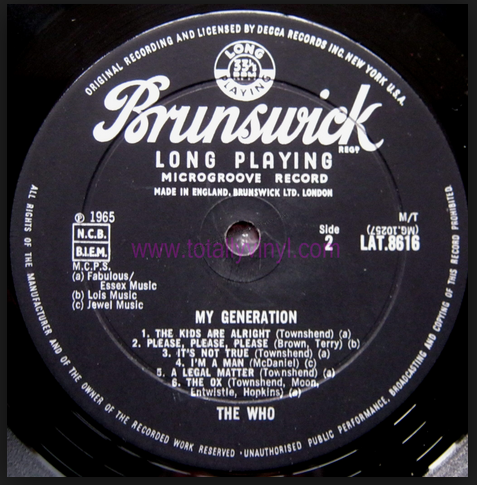
Decca would produce the Brunswick label in an LP and 45 formats in the 1950s.
Music Genres: Blues, Pop, Jazz, re-issues.
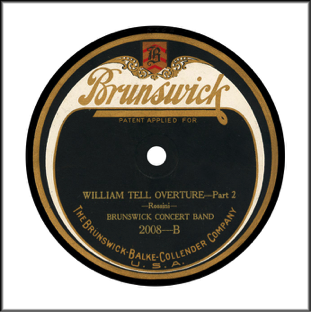
Pre-1941 Label: The first label was between 1916-1924. Note the “B” side. The record came in many colors including black, purple, yellow, green, and blue. All have a similar design.
Brunswick 1916-1924
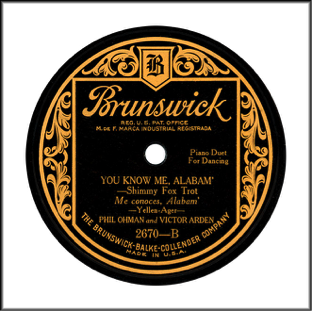
A second label redesign occurred between 1924-1928. Note the “B” side. Brunswick design now black and gold shield with a scrolled border. Colors may be tan or purple.
Brunswick 1924-1928
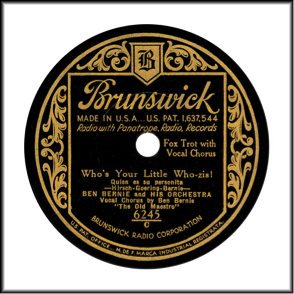
A slight modification occurred between 1928-1940. Brunswick would underline the preferred side. If the record has an underlined side and has the phrase “The Brunswick-Balke-Collender Company” at the bottom, it was made probably between 1928-1930. That is the time after the underlining was introduced yet before being leased to ARC. After being leased to ARC, records between 1930-1938 would carry a statement that they were “Manufactured by in the USA by Brunswick Radio Corp.”
Brunswick 1928-1940. Note the phrase “Brunswick Radio Corporation” at the bottom.
A Hall of Fame series made by Brunswick came out between 1924-and 1934. Yellow/Gold in color.
Brunswick Hall of Fame Series
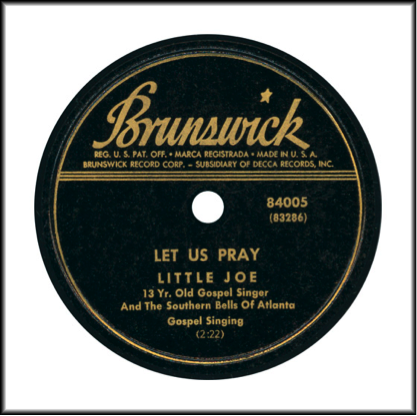
1941-1945s Label: When the record label was sold to Decca in 1944, they adopted the Brunswick label to sell their Collector Series. The collector series is displayed predominately at the top. Decca also released reissues under the Brunswick label. These labels display the phrase “Subsidiary of Decca Records, Inc.”.
World History II: Premium Lesson Plan-Review of Isms Premium Lesson Plans: Review of Isms Student Worksheet : Student 40-question worksheet on important World History II ideas and “isms”. Answers to the ism worksheet are in a PowerPoint format.
World History II Review of Isms and Topics
World History II: Premium Lesson Plan- Review of Revolutions, Wars and Conflicts
Premium Lesson Plans: Review of Revolutions Wars and Conflicts : Student 47 question matching worksheet with word-bank on important World History II Wars, Conflicts, and Revolutions. Answers to the worksheet are in a PowerPoint format.
Premium Lesson Plan: World Religions Review: Study Guide/Review worksheet that covers the major world religions with a focus on Christianity, Islam, and Judaism. Includes student questions and three images. No maps are included.
World Geography SOL Word Bank Review : Review packet that includes questions from all the World Geography SOLs. For each set of questions, students are given a word bank to select answers. Includes Answers.
The Aeolian-Vocalion was created by the Aeolian Piano Company in 1916. The Piano company produced, besides pianos, phonographs. Having a record label was the natural extension. In Aug. 1920 Aeolian introduced reddish-orange pressings. In 1921 the title label “Aeolian-Vocalion” was replaced by just the “Vocalion” title label in a black and gold color scheme. Acquired by Brunswick Records in 1925, Brunswick would keep the black and gold color scheme and add the phrase “Brunswick Record Corporation” at the bottom. American Record Company (ARC) would acquire leasing rights to Brunswick Records (including Vocalion) in late 1935 and create a glossy black design. It would stay that way until 1937 when the label turned a bright blue.
The bright blue label would last until 1940 when Vocalion was acquired by Columbia Broadcasting System (CBS) and discontinued. The Vocalion catalog was then re-leased under the CBS name. Delta Blues singer Robert Johnson first recorded on the Vocalion label in 1936-1937.
The Aeolian-Vocalion recording studio was located at Aeolian Hall in New York. There were pressing plants in New York and Meridan, Connecticut.
Music Genres: Race-Records, Blues, Specialties, Swing, Country, Western swing.
Pre-1941 Label: Some are in black shellac and some are in reddish-brownish shellac.
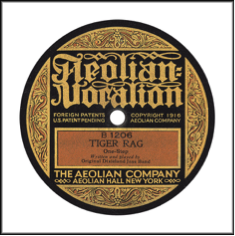
Aeolian-Vocalion Record Label: 1916-1920. This record is pressed in black. Tiger Rag by the Original Dixieland Jass Band was first released on the label.
Record Label: 1916-1920. Label colors: Tan, Gold, Black.
Tiger Rag-
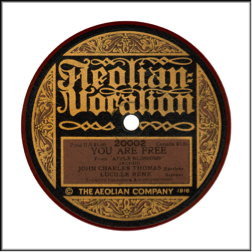
Aeolian-Vocalion Record Label: 1920. Pressed in red. The song titled “You are Free: From Apple Blossoms” is recorded by John Charles Thomas who was a baritone with a “beautiful voice”. Though, Fritz Kreisler and Viktor Jacobi initially wrote the song.
Record Label: Aug. 1920. Red Record color.
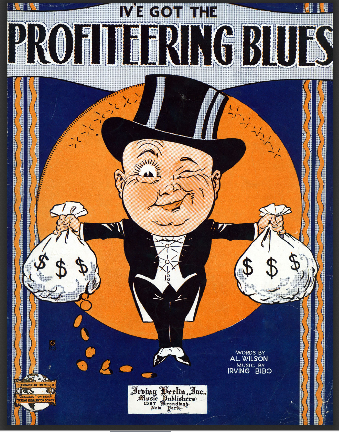
“The Profiteering Blues” was written by Irving Bibo and sung by Bill Murray. Bill Murray was an early 20th-century singer and entertainer.
Profiteering Blues
Record Label: Jan 1920
“The Profiteering Blues” on Aeolian-Vocalion by Bill Murray
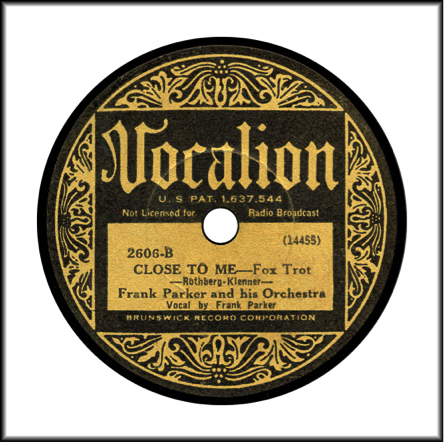
Aeolian-Vocalion Record Label: In 1921, the label drops “Aeolian-Vocalion” in favor of just “Vocalion”. When it was bought by Brunswick Records in Nov. 1924, the phrase of “Brunswick Record Corporation” is added at the bottom.
Record Label: 1925-1935 Black and Gold scroll. Note “Brunswick Record Corporation” at the bottom.
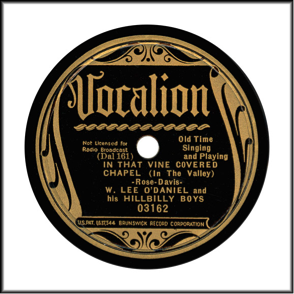
Aeolian-Vocalion Record Label: In the mid-1930s, Brunswick redesigns the label to have a glossy black finish with the label name, artist, and other record information in a scroll-like shape. The song on this label, “In That Vine Covered Chapel (In the Valley)” was sung by Lee O’Daniel and his Hillbilly Boys. The group is an example of western-swing.
Record Label: 1935-1937. Glossy black.
Aeolian-Vocalion Record Label: Late 1930s, the label goes to a Blue and Tan color scheme.
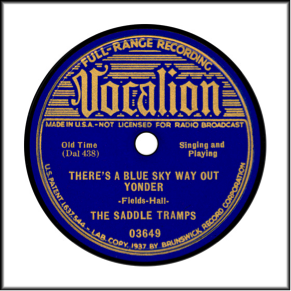
Record Label: 1937-1940. Bright blue label.
“There’s a Blue Sky Way Out Yonder” by the Saddle Tramps
1941-1945s Label: None
Post WW2 Label: None
Numbers from start to 1945: 1000-70000
Notes: #1000 is the race-record series. The Hoosier Hot Shots, a string quartet band known for their unusual instruments, is also recorded on the label.
Sources:
-John Charles Thomas Biography Sheet from the University of Iowa —www.78rpmrecord.com –Aeolian-Vocalion Discography : For a complete discography see “Vocalion” at the bottom. —http://www.capsnews.org/barrbru.htm: Brunswick and Vocalion –Rust, Brian. The American Record Label Book. Arlington House Publishers, NY. 1978. –Sutton, Nauck. American Record Labels and Companies: An Encyclopedia (1891-1943). Mainspring Press, CO. 2000
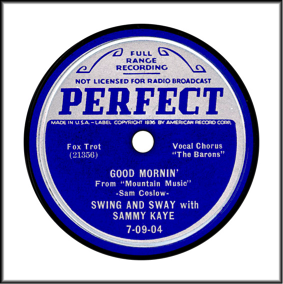
A budget brand of the Pathe-Actuelle Label. The Perfect Record Label operated under the Pathe-Actuelle controlled Perfect Record Company. Early Perfect labels were black for popular music or maroon for classical. These early labels used an octagonal border. By 1923, the label design changed to two nude sun-worshippers. Red shellac pressings were introduced in late 1924 but discontinued in 1931 in favor of black shellac. Perfect created a series called Perfect Star Series for higher-end talent. After being bought by the American Record Company (ARC) in 1929 the label remained the same until a re-design in 1937 to an undistinguished blue-and-silver label without a pictorial trademark. Perfect would be discontinued by ARC in April 1938.
Music Genres: Pop, Orchestra, Classical, Band, Blues
Pre-1941 Label:
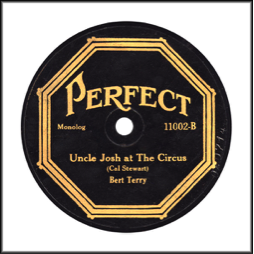
Perfect Record Label: 1922-1923. Notice the octagonal border.
Perfect Record Label. Early
Uncle Josh (Cal Stewart) was a monologuist known for telling humorous stories with a unique laugh. I’ve included a link to the audio of Uncle Josh at the Circus below. It is on a Columbia record.
http://www.youtube.com/watch?v=1GvmVTtZy6g
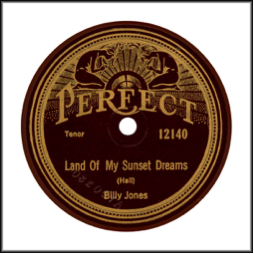
Perfect Record Label: 1923-1937. The record may be black, blue, green, or red shellac with nude sun-worshippers.
Notes: The Race record series was called Perfect 100s. It was started in July 1926. These were duplicates of Pathe’s race series (#7500). Rosa Henderson and Mary Staffard would feature prominently on the Perfect race-record series. Another race artist include Big Bill Broonzy (operating under the pseudonym of Sammy Sampson). Big Bill would also have a side project with Tommy Dorsey, called The Famous Hokum Boys.
Founded in France and came to the US in 1914 as the Pathe-Freres Phonograph Company. Pathe-US would introduce a short-lived budget brand called Sapphire in 1915. Another label called Actuelle would be created in Sept. 1920. The Actuelle label was at first red, black, and gold on a buff, white, or another color background. They were replaced by a similar label in 1922 of gold and black for popular music or gold and maroon for classical. In 1922 the Pathe-Freres Phonograph Company went bankrupt.
By Nov. 1922 Pathe-Freres was re-organized as the Pathe Phonograph and Radio Corporation. They would introduce two new labels: Perfect and Pathe-Actuelle. The Pathe-Actuelle (sometimes referred to as Pathe) label had a race record series that was introduced in 1924. Pathe-Actuelle and Perfect were merged with the Cameo Record Corporation in Oct. 1927. Two years later, Cameo was bought by the American Record Corporation (ARC) in 1929. ARC dropped Pathe in March 1930 and Perfect in 1938. The Perfect record label can sometimes be seen in red shellac rather than black.
Music Genres: Pop, Orchestra, Classical, Band, Blues
Pre-1941 Label:
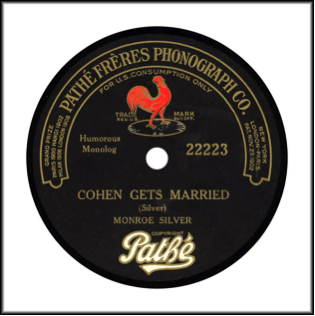
Pathe Record Label would last from 1914-1922. In 1922, Pathe-Freres would reorganize as a different company and created a different label.
Pathe Label, 1914. Note the Chicken
The Sapphire Record Label, 1915.
Sapphire Record 1915
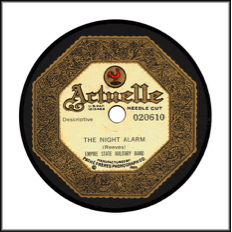
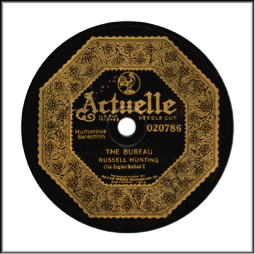
Actuelle Label, 1920. This would replace Sapphire as a budget brand label.
Actuelle Label redesign in 1922. This redesign would not last for long as Pathe-Freres would reorganize as a different company the same year.
Actuelle Label, 1922
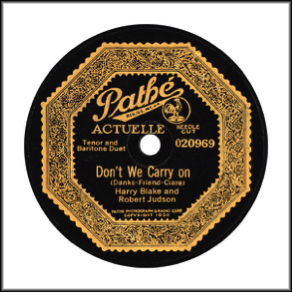
Pathe-Actuelle Label, 1922. This was the new label of the former Pathe-Freres company, now reorganized as the Pathe Phonograph and Radio Corporation. After ARC buys the corporation in 1929, they would drop the label.
Pathe-Actuelle Label, 1922.
1941-1945 Label: None Post-WW2 Label: None Numbers from start to 1945: 10000-60000
Notes: The Perfect Record Label went from #100-16000
Sources: -Rust, Brian. The American Record Label Book. Arlington House Publishers, NY. 1978. -Sutton, Nauck. American Record Labels and Companies: An Encyclopedia (1891-1943). Mainspring Press, CO.2000.
Lesson Plans World History II SOL 12c: Outcomes of World War II
Standard WH II: The student will demonstrate knowledge of the worldwide impact of World War II by
Objectives: Explaining the terms of the peace, the war crimes trials, the division of Europe, plans to rebuild Germany and Japan, and the creation of international cooperative organizations and the Universal Declaration of Human Rights (1948).
Lesson Plans
Introduction: A Bell-ringer activity
Notes: Students copy-down and discuss teacher generated notes
Activities: Students complete various in class activities to support learning including video analysis, maps, charts, diagrams, graphic organizers, worksheets, text-book questions, group discussion, KWL Charts etc.
Assessment: Informal, Formal, Exit-Questions, Teacher Questioning. Quizzes, Tests, Projects
Essential Knowledge:
Outcomes of World War II
Loss of empires by European powers
Establishment of two major powers in the world: The United States and the U.S.S.R.
War crimes trials
Division of Europe, Iron Curtain
Establishment of the United Nations
The Universal Declaration of Human Rights
Marshall Plan
Formation of North Atlantic Treaty Organization (NATO) and Warsaw Pact
Efforts for reconstruction of Germany
Democratic government installed in West Germany and West Berlin
Germany and Berlin divided among the four Allied powers
Emergence of West Germany as economic power in postwar Europe
Efforts for reconstruction of Japan
United States occupation of Japan under MacArthur’s administration
Democracy and economic development
Elimination of Japan’s military offensive capabilities; guarantee of Japan’s security by the United States
Emergence of Japan as dominant economy in Asia
International Cooperative Organizations
United Nations
North Atlantic Treaty Organization (NATO)
Warsaw Pact
The Universal Declaration of Human Rights
Established and adopted by members of the United Nations
Provided a code of conduct for the treatment of people under the protection of their government
Standards SOL 12a: The student will demonstrate knowledge of the worldwide impact of World War II by
Objective: Examining the Holocaust and other examples of genocide in the twentieth century.
Essential Knowledge:
• Genocide: The systematic and purposeful destruction of a racial, political, religious, or cultural group
• Totalitarianism combined with nationalism
• History of anti-Semitism
• Defeat in World War I and economic depression blamed on German Jews
• Hitler’s belief in the master race
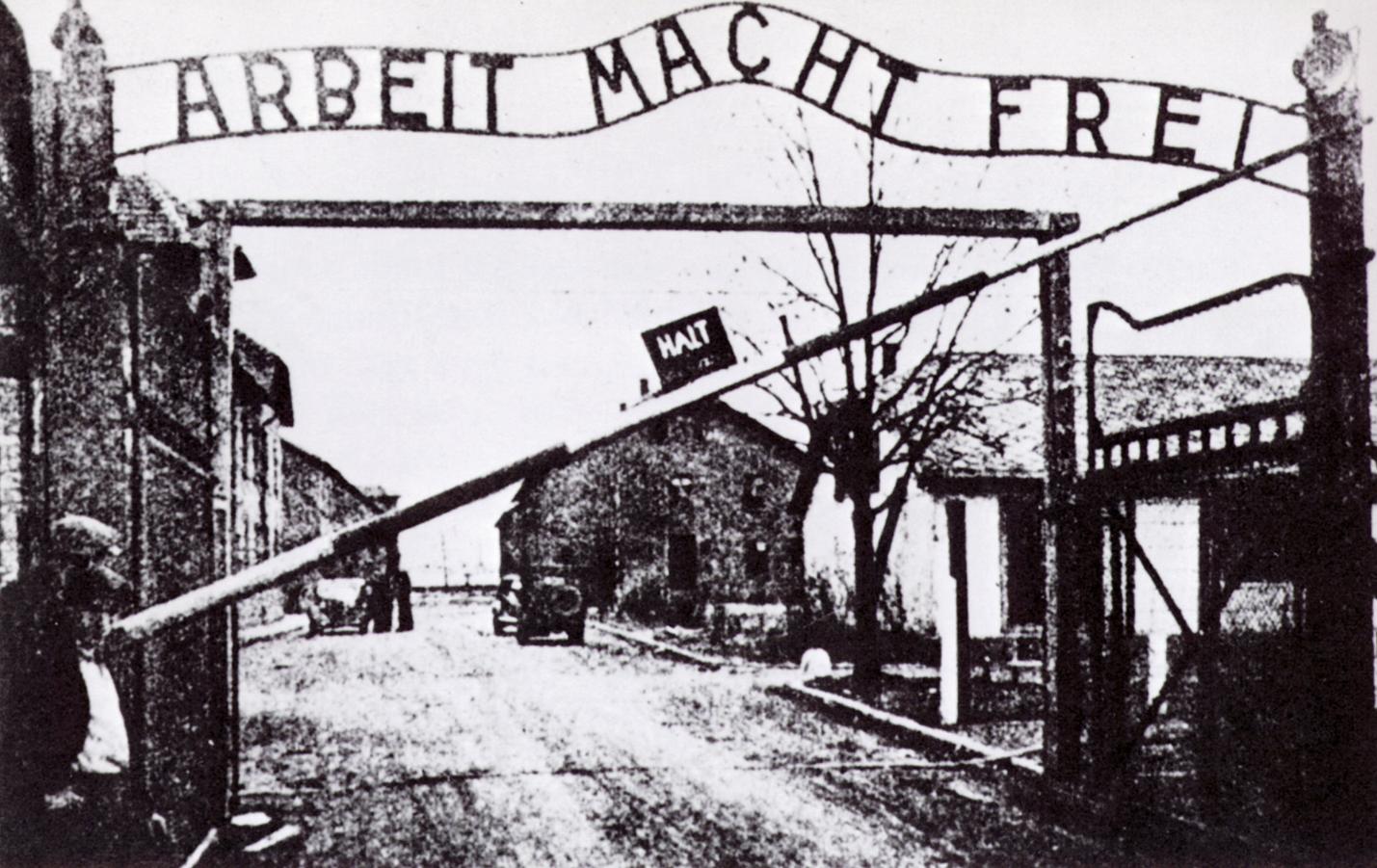
• Final solution: Extermination camps, gas chambers Other examples of genocide
• Armenians by leaders of the Ottoman Empire
• Peasants, government and military leaders, and members of the elite in the Soviet Union by Joseph Stalin
• Artists, technicians, former government officials, monks, minorities, and other educated individuals by Pol Pot in Cambodia
• Tutsi minority by Hutu in Rwanda
Lesson Plans World History II SOL 12a: Start of World War II, Events, Leaders
Standard: SOL 12a The student will demonstrate knowledge of the worldwide impact of World War II
Objective: explain economic and political causes, describing major events, and identifying leaders of the war, with emphasis on Franklin D. Roosevelt, Harry Truman, Dwight D. Eisenhower, Douglas MacArthur, George C. Marshall, Winston Churchill, Joseph Stalin, Adolf Hitler, Hideki Tojo, and Hirohito.
Essential Knowledge: Economic and political causes of World War II
• Aggression by the totalitarian powers of Germany, Italy, Japan
• Nationalism
• Failures of the Treaty of Versailles
• Weakness of the League of Nations
• Appeasement
• Tendencies towards isolationism and pacifism in Europe and the United States
Major events of the war (1939–1945)
• German invasion of Poland
• Fall of France
• Battle of Britain
• German invasion of the Soviet Union
• Japanese attack on Pearl Harbor
• D-Day (Allied invasion of Europe)
• Atomic bombs dropped on Hiroshima and Nagasaki
Major leaders of the war
• Franklin D. Roosevelt: U.S. president
• Harry Truman: U.S. president after death of President Roosevelt
• Dwight D. Eisenhower: Allied commander in Europe
• Douglas MacArthur: U.S. general
• George C. Marshall: U.S. general
• Winston Churchill: British prime minister
• Joseph Stalin: Soviet dictator
• Adolf Hitler: Nazi dictator of Germany
• Hideki Tojo: Japanese general
• Hirohito: Emperor of Japan