Sources: –Rust, Brian. The American Record Label Book. Arlington House Publishers, NY. 1978. –Sutton, Nauck. American Record Labels and Companies: An Encyclopedia (1891-1943). Mainspring Press, CO.2000.
Victor Records (1901-1929; after which it is part of RCA)
Founded as Victor Talking Machine Company in 1901. The phrase “His Master’s Voice” appears on discs in 1902. Marketed a Victor Monarch Record label (1902-1905) and a De Luxe Label (1902-1905; a De Luxe Special Record that was 14in. was sold from 1902-1903) both would have the dog and gramophone logo. The Victor Monarch Label and the De Luxe Label would also be sold alongside a regular Victor Label or Victor Record Label. The first discs were one-sided and starting around 1908 Victor began to produce two-sided discs. Some early Victors from 1905-1913 will say around the rim “Awarded First Prize…” as Victor was awarded first place at expositions.
A Red Seal Record series (originally one-sided and then two-sided in 1921) would be introduced in 1903 and last till 1923 the design of the Red Seal record would mimic the regular label. The Red Seal series featured higher-end musicians such as Enrico Caruso and cost anywhere between $1-$7.50 which is much more expensive than the regular series records.
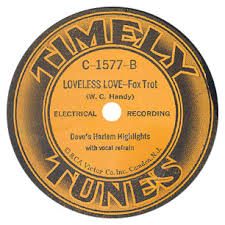
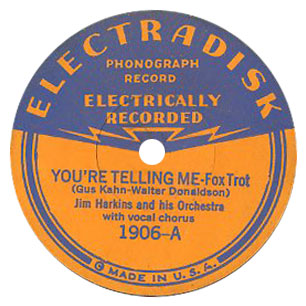
In 1929 the Victor Talking Machine was sold to Radio Corporation of America and would operate as RCA-Victor. RCA-Victor would produce budget labels like Timely Tunes(#1550-1600) produced between April 1931 and July 1931 and Electradisk (#1900-2510) produced between 1932-1934 for Woolworth Department Stores. However, the Bluebird label would be its best. In 1936, RCA-Victor would abandon the scrolled design. In 1942, RCA-Victor would introduce a 2-digit pre-fix for record series. In 1946 RCA would RCA on all the records making them RCA-Victor. By the late 1940s/early 1950s RCA-Victor would make the switch to 45s and Long Play (LP) discs. Music Genres: Jazz, Blues, Classical, “rock and roll”, philharmonic, country/western music, sound recordings, dance
Pre-1941 Label:
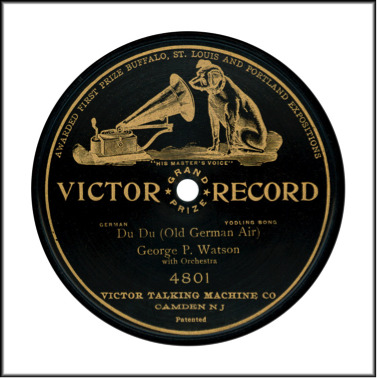
Early Victor: 1905-1914 (records from 1908-1914 would feature the word “Patents” at the bottom).
Record Label: Early 1905-1908. Note “Grand Prize” in the center. Records from 1908-to 1914 would feature “Patents” dates/information listed at the bottom of the record.
Du Du (Old German Air) on Early Victor by George P Watson
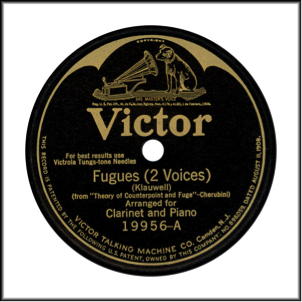
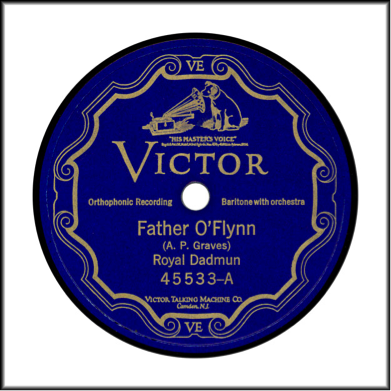
Mid Victor: 1914-1926 the “Batwing” design. 1926-1936 the “Scrolled” design.
Record Label: Jan. 1914-Oct. 1926. Note the arch (“Batwing”) at the top of the label. It may be in blue, black, purple or red.
Record Label: Oct. 1926-Oct. 1936. Scrolled design. Note the absence of patent numbers and copyright warnings. See also the mention of “Orthophonic Recording” and the “VE” at the bottom/top. This means the record has been electrically recorded. May also be in blue, black, red, and maroon.
Late Victor: 1936-1946. Concentric Circles with the Victor title label.
Record Label: 1936-1946. Note “Circles” on edge of the label. May be blue or purple, red, maroon, or orange.
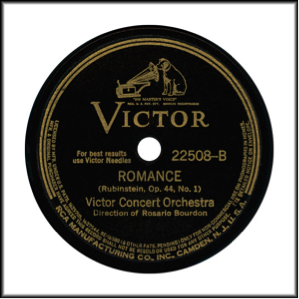
While not on a late Victor recording, Romance by the Victor Concert Orchestra:
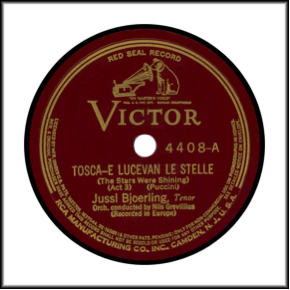
Red Seal Label: 1903-1923
Record Label: 1903-1923. Red in color with the phrase Red Seal Record at the top.
1941-1945 Label: 1942 label with RCA-Victor.
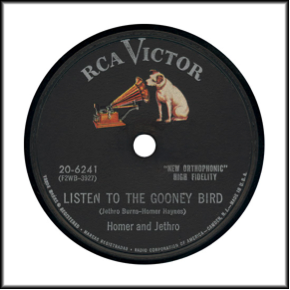
Record Label: 1942. Note the 2-digit pre-fix for the record series and the lack of a scroll design. Note the colorization of the dog.
Listen to the Gooney Bird by Homer and Jethro, a pair of country musicians.
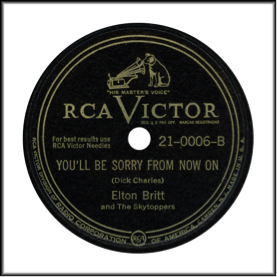
Post-WW2 Label: 1946
Record Label: 1946 as identified with RCA-Victor label. It may be seen in blue (Bluebird Series), Red, Black, or Silver and Black. Note the circles on the edge.
Timely Tunes Budget Label: April 1931 and July 1931
Electradisk Budget Label: 1932-1934
Electradisk Victor Budget Label
While not the name of the disk, here is Jim Harkins on Electradisk playing a song called Play Fiddle, Play.
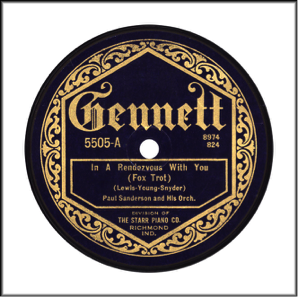
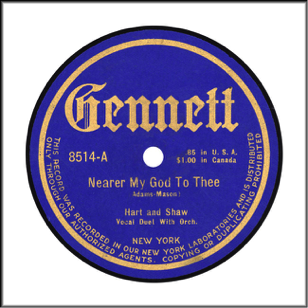
The Gennett label was created by Starr Piano Company. The first records produced were under the Starr (1916-1917) label. The Starr label was replaced by the Gennett label. Early Gennett labels were plain but between 1920-and 1927 they would feature a hexagon. In 1927 Gennett would add the phrase “Electobeam” to its label pressings. Starr Piano would cease selling the Gennett label commercially in 1930 (Gennett would live on till 1934 as a custom label) and concentrate on its budget brands: Champion, Superior, Buddy, and Supertone (pressed for Sears).
Superior (#2500-2839) was produced between 1930-and 1932. Gennett would often press records for other labels/companies. Appears to be mostly re-issues. Label design unknown.
Music Genres: Country, Jazz, Blues, “Race-Records”, Gospel, novelty, obscure, Hopi Indian Songs, political speeches, sound effects, Christmas greetings, and Klu Klux Klan Propaganda (pressed on the KKK’s labels 100%, 100% American, Hitch, or KKK)
Early Gennett
Record Label: 1917-1920. Plain. May also be in red.
Mid-Gennett
Record Label: 1920-1927. Featuring a hexagon. It maybe in red, blue, green, maroon, or black.
Late Gennett
Record Label: 1927-1930. Black and Gold. Note the phrase “Electrobeam”
1941-1945s Label: None
Post-WW2 Label: None Numbers from start to 1945: 2500-19000
Notes: Many famous musicians first recorded under the Gennett label (Louis Armstrong, King Oliver, Jelly-Roll Morton, Blind Lemon Johnson, Bix Beiderbecke, Gene Autry).
An example of King Oliver, Froggie Moore, on Gennett
An example of Louis Armstrong, Canal Street Blues on Gennett
Sources: –http://www.starrgennett.org/stories/history/1.htm -Rust, Brian. The American Record Label Book. Arlington House Publishers, NY. 1978. -Sutton, Nauck. American Record Labels and Companies: An Encyclopedia (1891-1943). Mainspring Press, CO.2000.
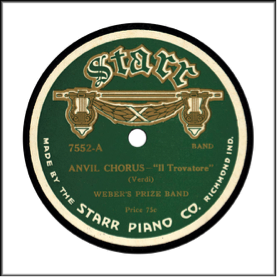
The Starr label was the Starr Piano Company’s first label. The records were produced for one year between 1916-1917 label. The Starr label was replaced by the Gennett label as the company wanted to break into new channels and distance itself from the “Piano” side of the business.
Music Genres: Country, Jazz, Blues, “Race-Records”, Gospel, novelty, obscure, Hopi Indian Songs, political speeches, sound effects, Christmas greetings, and Klu Klux Klan Propaganda (pressed on the KKK’s labels 100%, 100% American, Hitch, or KKK)
Starr Label
Record Label: 1916-1917. Early Starr Piano Label
1941-1945s Label: None
Post-WW2 Label: None Numbers from start to 1945: Unknown
Notes: none
Sources: –http://www.starrgennett.org/stories/history/1.htm -Rust, Brian. The American Record Label Book. Arlington House Publishers, NY. 1978. -Sutton, Nauck. American Record Labels and Companies: An Encyclopedia (1891-1943). Mainspring Press, CO.2000.
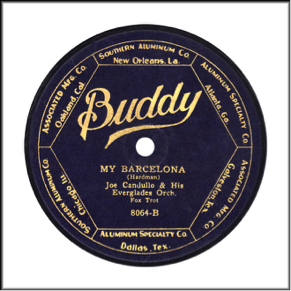
The Buddy Label was produced between 1923-and 1926 by Starr Piano Company. The label featured companies along the side that had nothing to do with Starr Piano.
Music Genres: Country, Jazz, Blues, “Race-Records”, Gospel, novelty, obscure, Hopi Indian Songs, political speeches, sound effects, Christmas greetings, and Klu Klux Klan Propaganda (pressed on the KKK’s labels 100%, 100% American, Hitch, or KKK)
Buddy Label
Buddy Record Label: 1923-1926
1941-1945s Label: None
Post-WW2 Label: None Numbers from start to 1945: #8000-8100
Notes: None
Sources: –http://www.starrgennett.org/stories/history/1.htm -Rust, Brian. The American Record Label Book. Arlington House Publishers, NY. 1978. -Sutton, Nauck. American Record Labels and Companies: An Encyclopedia (1891-1943). Mainspring Press, CO.2000.
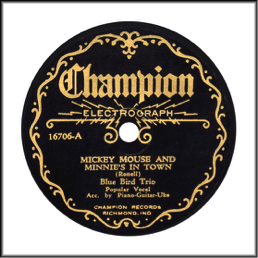
The Starr Piano Company produced the budget Champion Label from 1925 to Dec. 1934 and would often feature a release of a Gennett artist under a different name to avoid paying royalties. In 1927, the Champion label appeared with the word “Electrograph.” Champion records may be blue, black, or red. The Champion label was sold to Decca in June 1935. Decca would remove the word “Electrograph” and add the phrase “Electrically Recorded.” Decca discontinued the Champion label in April 1936.
Music Genres: Country, Jazz, Blues, “Race-Records”, Gospel, novelty, obscure, Hopi Indian Songs, political speeches, sound effects, Christmas greetings, and Klu Klux Klan Propaganda (pressed on the KKK’s labels 100%, 100% American, Hitch, or KKK)
Early Champion Label
Champion Record Label: 1925-1927.
Late Champion Label
Record Label: 1927-1936. Note the word “Electrograph” beneath the Champion label.
While not on a Champion Record, the song Mickey Mouse and Minnie’s in Town is just too cool not to hear:
1941-1945 Label: None
Post-WW2 Label: None Numbers from start to 1945: #15000-16832
Notes: none
Sources: –http://www.starrgennett.org/stories/history/1.htm -Rust, Brian. The American Record Label Book. Arlington House Publishers, NY. 1978. -Sutton, Nauck. American Record Labels and Companies: An Encyclopedia (1891-1943). Mainspring Press, CO.2000.
Collapse is a National Geographic film that looks at societies in the past for how they collapsed and disappeared. It’s a good film to use with the lesson plans below as it forces students to think critically about current society.
Premium Lesson Plans
I have a set of premium lesson plans you can use with the film. It has a viewing guide and a student discussion sheet where they analyze three different cultures(Anasazi, Vikings, Easter Islanders), complete charts, and answer questions. As well as a PowerPoint to help lead a discussion and provide instruction.
If you’re not interested in the premium lesson plans you can use the free handouts I’ve reworked from a Tread Lightly lesson plan to make your own. It contains three different cultures students need to analyze as well as a review of the causes and consequences of Climate Change.
Film: Note: Full copies may be purchased from National Geographic. The video below comes in parts.
Standards: The student will demonstrate knowledge of cultural, economic, and social conditions in developed and developing nations of the contemporary world by
Objectives: Analyzing the increasing impact of terrorism.
Lesson Plans: Introduction: A Bell-ringer activity
Notes: Students copy-down and discuss teacher generated notes
Activities: Students complete various in class activities to support learning including video analysis, maps, charts, diagrams, graphic organizers, worksheets, text-book questions, group discussion, KWL Charts etc.
Assessment: Informal, Formal, Exit-Questions, Teacher Questioning. Quizzes, Tests, Projects.
Essential Knowledge:
Examples of international terrorism
• Munich Olympics
• Terrorist attacks in the United States
(e.g., 9/11/2001) motivated by extremism (Osama bin Laden).
• Car bombings
• Suicide bombers
• Airline hijackers Governmental responses to terrorist activities
• Surveillance
• Review of privacy rights
• Security at ports and airports
• Identification badges and photos
Activities that support lesson plans Terrorism Analysis chart Questions Questions for use with Chart in World History II Scope and Sequence.
Lesson Plans: World History II SOL 16c Economic Interdependence
Standards: The student will demonstrate knowledge of cultural, economic, and social conditions in developed and developing nations of the contemporary world by
Objectives: Describing economic interdependence, including the rise of multinational corporations, international organizations, and trade agreements.
Lesson Plans: Introduction: A Bell-ringer activity
Notes: Students copy-down and discuss teacher generated notes
Activities: Students complete various in class activities to support learning including video analysis, maps, charts, diagrams, graphic organizers, worksheets, text-book questions, group discussion, KWL Charts etc.
Assessment: Informal, Formal, Exit-Questions, Teacher Questioning. Quizzes, Tests, Projects.
Essential Knowledge:
Economic interdependence
• Role of rapid transportation, communication, and computer networks
• Rise and influence of multinational corporations
• Changing role of international boundaries
• Regional integration, e.g., European Union
• Trade agreements, e.g., North American Free Trade Agreement (NAFTA), World Trade Organization (WTO)
• International organizations, e.g., United Nations (UN), International Monetary Fund (IMF)