Before Fair Radio went out of business, I had the opportunity to pick through it a bit. Much of the WWII stuff was gone, but they did have a few PRC-6s.
I was able to find enough parts to complete the unit, including the mic and antenna.
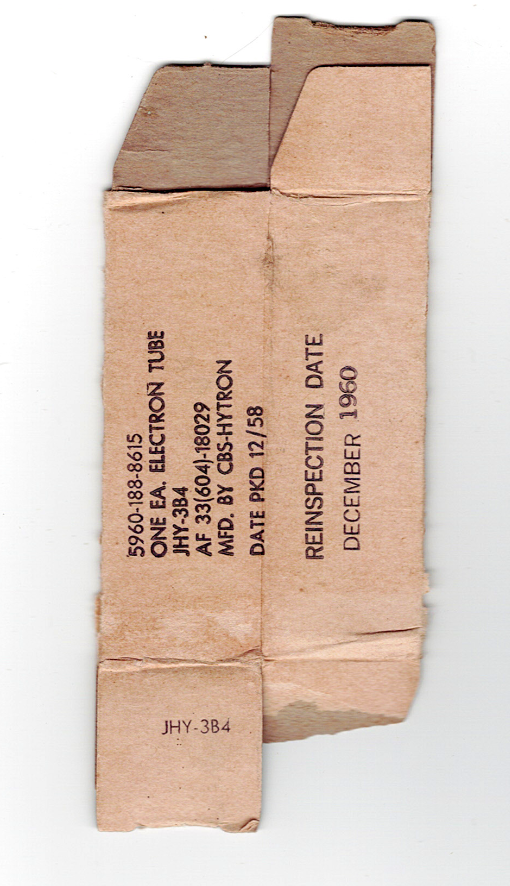
The one thing it was missing was this JHY 3B4 tube. I found one on ebay for 9 dollars in Jan 2024. Below is what the box looked like. It was 4.5in long (from one end of the box wings to the other) and 2in high. You can download a pdf of the box if needed.
It was also missing the primary crystal, CR-23/U Quartz Radio Crystal HC-6/U, and the spare. I bought two for 32 dollars in Jan 2024. It did not come with box.
These types of events are characterized by organizers bringing together a bunch of units and having them fire and maneuver at each other throughout a weekend without any well-defined or planned tactical scenario. Often called a private tactical. These can be fun, but you have to insert yourself, as the organizers rarely think to include signal elements.
Due to the nature of these events, your best bet is to come with several sets of BC-611s. These are usually cheaper, lightweight, and reproductions of them exist. Plus, folks can kinda strap the radio to themselves and still be able to run and gun with their unit. They’re not inherently tied to a radio for the whole event.
I’ve personally done events where I brought a pair of BC-1000s, and while cool, it’s a lot more equipment to lug around. Plus, these are all originals and are prone to breaking (once an original short antenna broke at an event), and heavy and cumbersome. Folks are usually tied to the radio for the whole event.
You would want to get a list of units and approximate strength before the event and work up a set of Signal Operation Instructions (SOIs) that outline call signs and frequencies, as well as which unit gets which BC-611. You would probably want to include some basic communication procedures as well as the phonetic alphabet.
You would then request one soldier from each unit to attend an SOI briefing. Where you go over the BC611 usage, instructions, and communication procedures. You’d likely have anywhere between 15 minutes and 30 minutes before the event starts to do this. So keep the briefing short, quick, and memorable. They should be able to explain it back to you, and they should also be instructed to train several others in the unit.
Printing off the booklet below might be helpful, too.
Pamphlet 24-2 Radio Telephone Procedure Oct 22nd, 1943 – Part 1 and Part 2 | A short and small booklet that explains Radio Telephone Procedure. Print off part 1 on 8.5in by 14in. Beige light cardstock, flip it over, and print off part 2. Then cut and fold.
I haven’t tested it, but it looks like it’s going to end up being some kind of wallet-sized/index card-sized pamphlet. If you want it as an image, you can see part 1 and part 2 here.
You would likely want to keep batteries for the units and other repair tools in a crate near the starting point and instruct folks that if batteries run out, this is the Signal Supply depot.
Units then go out into the field, and you communicate. You pick up the radios at the end of the event or have them drop them off at the supply depot.
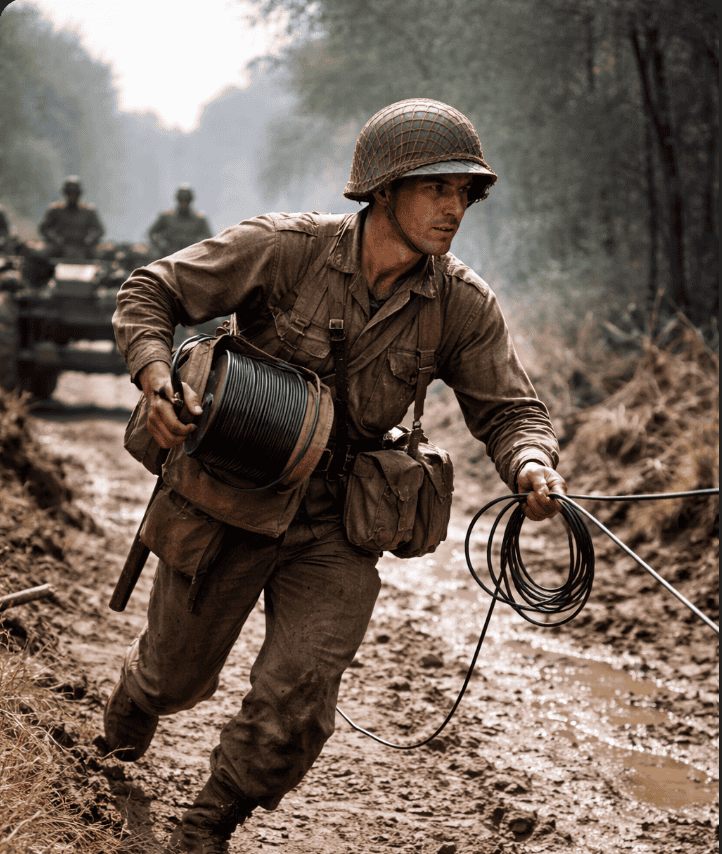
Ideally, you should be using wire, but the nature of these kinds of events doesn’t allow for it. Runners are also acceptable, but most folks in this type of event don’t want to stray from their unit or spend the entire weekend running messages.
Static Events
This kind of event is where there’s a fixed side. Italian events usually lend themselves to this kind of concept. The Great War Association in Newville usually has an Italian-type event called Winterline.
Another example is when there is an extended bivouac, like at the D-Day Conneaut event. For these events, there’s a side of the ground that is used as a launching point and where “command and control” can exist.
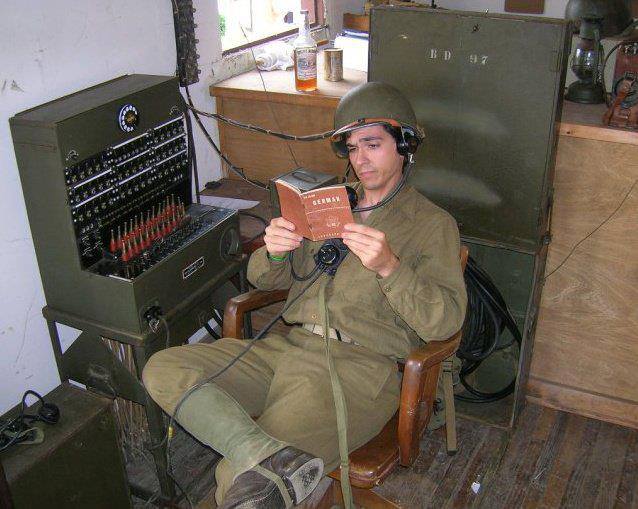
For this kind of event, wire would be more appropriate both in historical terms and in practical terms. You can set up a message center with a switchboard and run field phones and wire out to where units are located. The field phones are easy to set up and move, and aren’t cumbersome. Plus units are typically hanging around their area, so someone will be available to take and make calls.
You could provide a small booklet called a Signal Operations Instruction, which contains the codewords and frequencies. An example is this one: Signal Operation Instructions 84th Infantry Division. The booklet would be given to the unit commanders.
You would probably need one or two other people to assist with set-up, tactical operation, and take-down. Might want to consider rotating people out so the same group of people aren’t stuck doing wire. You would train these people at the headquarters on how to run the switchboard and check wires. You could even do a wire patrol scenario where you go check the wires.
Before the event starts, you would have an SOI briefing with a representative of the units who get field phones. You’d go over the basics of field phone operation and communication, and probably hand them Pamphlet 24-2. Extra equipment, such as batteries and tools, would be located at the Message Center (aka) Headquarters.
Depending on how much time and how large the event is, you could implement the flow chart below.
Message Routing Procedure Flow Charts – Describes the routing of different kinds of messages when message center facilities are or aren’t available.
Combination Events
These events combine elements of both. Usually, these are more managed and mission-focused. For example, the “command and control” element would create a mission where you have to string 5 field phones to 5 unit positions. Or the event organizers create an expectation that folks will use a radio net. The missions might be worth a certain number of points, and the event has referees to make determinations of points/mission success and/or hits/kills, etc.
I once attended a Sons of Valor event in South Carolina (or maybe North Carolina?) in the early 2010s and provided cover to an engineering unit that actually built a bridge over a ravine and a transportation corps unit that then drove a jeep across it to deliver supplies.
Obviously, this requires event planners or organizers to think holistically and do a lot of planning up front to make it interesting, fun, and memorable.
But there’s more openness to providing SOI briefings and signal corps elements.
Living History Events
These events are characterized as being more for the public and carry an assumption that reenactors will interact with the public and share their displays. Some events include aspects of the above, but it’s mainly about engaging the public.
These can be interesting for signal corps elements, as you could demonstrate pole climbing, have kids run wire, splice wire, or operate switchboards etc.
You could provide folks with an SOI and let them communicate over a radio network.