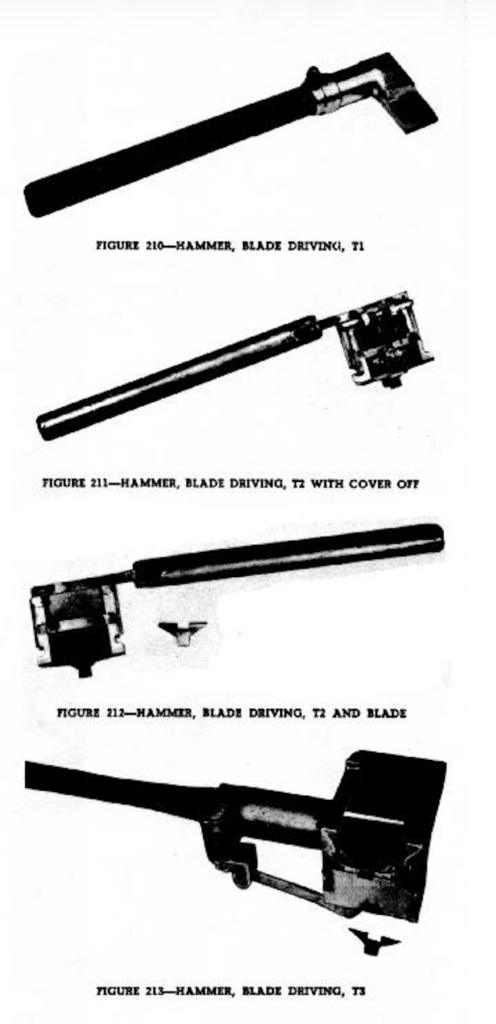
Early in January 1944 it was established that razor blades had been used as an anti-sniper device in action against the Japanese. The insertion of several blades in trees which were likely to be used by enemy snipers provided an effective means of preventing these snipers from taking position in these trees after infiltrating through the lines at night.
Initially, investigation was made toward the possibility of utilizing tools similar to stapling tools and glazier’s point driving tools to accomplish the desired results. However, it was found that a fully automatic device based on such designs would be entirely too heavy.
Further investigation and development resulted in the following described types of blade-driving hammers:
a. Hammer, Blade Driving, T1
A wood handle with a metal head which holds a triangular-shaped blade. Individual blades are inserted into trees by swinging the device in a manner similar to using a regular hammer. This item was developed by the Magazine Repeating Razor Company (Fig. 210).
b. Hammer, Blade Driving, T2
A metal handle with a metal head containing a magazine and feeding device. A single “T”-shaped blade is inserted into the tree with each stroke of the hammer head, the device recocking itself with each backward stroke. This item weighs 13½ pounds and was developed by the International Staple and Machine Company (Figs. 211 and 212).
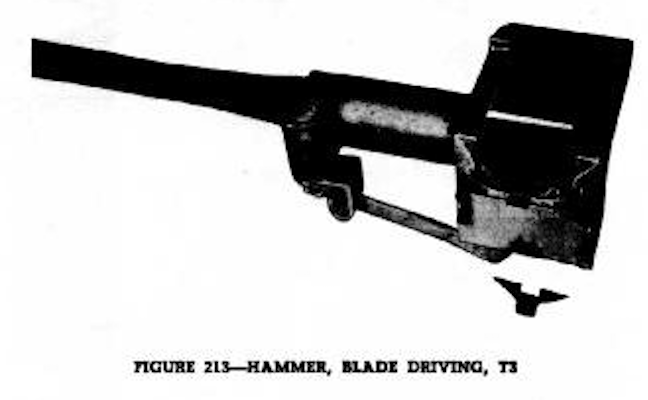
c. Hammer, Blade Driving, T3
A brass handle with a steel head containing a blade magazine. This device is semi-automatic in operation and is hand cocked each time it is desired to drive a blade into a tree. This item was also developed by the International Staple and Machine Company (fig. 213).
The T3 Blade Driving Hammer together with the specially designed blades were submitted in turn to Headquarters, Army Ground Forces and the U.S. Marine Corps who indicated that mechanical means were not required to accomplish the desired results and recommended that no further development be undertaken.