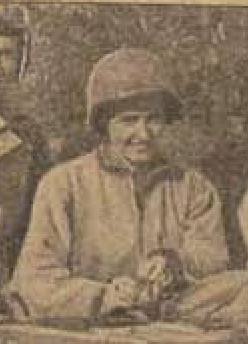
Taken from a Stars and Stripes weekly publication, Wednesday, September 27th 1944. Monica Storrs (her name is also Monique Storrs Booz) ended up getting a La Croix de Guerre for her actions, but never an official commendation.
You can find her family correspondence and history at the Newberry Library in Chicago, IL: https://archives.newberry.org/repositories/2/resources/706
Chicago Miss Is Getting Even With Gestapo And French Jail
By Ralph Harwood
Stars and Stripes Staff Writer
WITH U.S. FORCES NEAR METZ, Sept. 26 — At the front there is a good-looking girl in GI uniform who speaks English with the unmistakable accent of a Midwestern American. She speaks French like a native, too, and that’s her reason for being here.
Her name is Monica Storrs, and she calls Chicago home although she hasn’t been there for five years.
Anxious as she is to get back, however, she doesn’t plan on going until her service as an interpreter for a cavalry reconnaissance troop is no longer needed.
A Young Woman When Nazis Struck
Miss Storrs was in France with her parents in 1939 when the war broke out. The family remained in the country and was at Tours when the lightning German breakthrough occurred in 1940.
Although they could not get out, they had the protection of occupied France as long as Americans remained non-belligerents. Monica, then 23 years old, decided to study nursing.
Miss Storrs eventually became the head of a district for the French Red Cross, but her luck broke and she was denounced by Paris collaborators as soon as … The Gestapo took her into custody and she spent 21 miserable days in jail.
The day that advancing American units approached Blois, Monica was released along with other prisoners by French Resistance patrols. Recovering from Gestapo treatment and anxious to be of service to her country, this American girl walked up to the men of the cavalry reconnaissance troop which had entered the town first and identified herself.
Surprised as the men were to find an American girl in Blois, they were much more surprised when she asked if she could accompany them as an interpreter.
A Deal Is Made
A hurried conference among the troop and it was a deal. Monica Storrs was in — unofficially at first, true but […] Hoyle goes by the board plenty at the front and this was clearly a case of military expedience.
The troop lost no time in putting their new “member” of GI outfit complete, from shoes like she never wore before to helmet netting. That was Aug 15th and she’s been with the outfit since.
They’ve covered hundreds of miles in northern and northeastern France, dashing into scores of towns and villages to get first-hand information about the enemy for the infantry units to which they’re attached.
Monica isn’t particularly concerned with just what her military status is and what would happen to her if she were captured by the enemy.
There have been close calls, but Miss Storrs enjoys the excitement. Nor does she appear uncomfortable in liberated territory, her principal worry being that this manner of living about the countryside day and night in a jeep is doing for her appearance.
“When I get back to the States after this is over,” she said, “I’m going to spend three or four weeks at the hairdresser’s.”
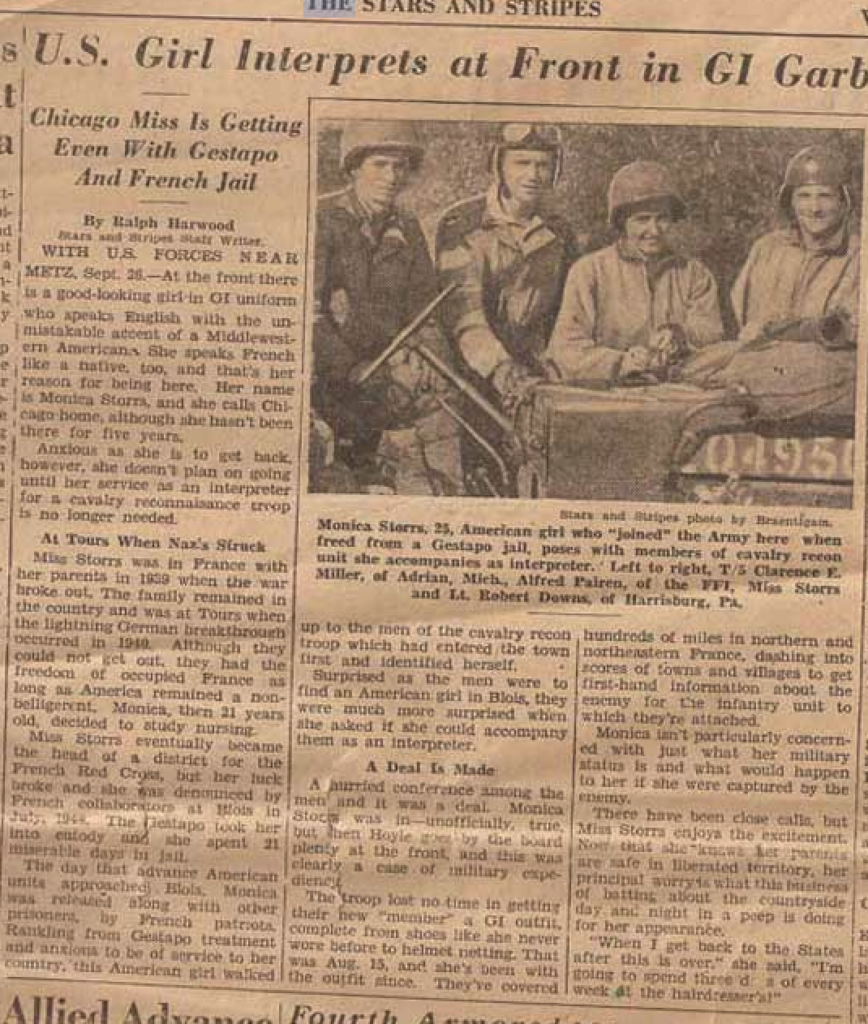
Monica Storrs, 28, American girl who “joined” the Army here after being freed from a Gestapo jail, poses with members of a cavalry reconnaissance unit she accompanies as interpreter. Left to Right: T/5 Clarence E Miller, of Adrian Mich, Alfred Palren of the FFI, Miss Storrs, and Lt Robert Downs of Harrisburg, PA.
The story was republished in an Oct 1944 version of Stars and Stripes