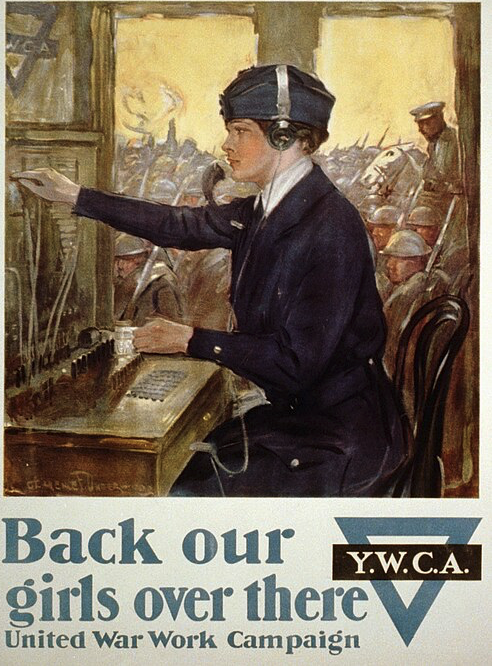
A cable from Headquarters, American Expeditionary Force to the Chief of Signal Corps (SC) on 10 November 1917 asked for 100 French-speaking female switchboard operators.[1] The cable noted, “…the unquestioned superiority of women as telephone operators…and the desire to release for service in the more dangerous telephone centrals at the front, male operators on duty in the larger offices.”[2]
On 10 November, SC asked American Telephone and Telegraph (ATT) to handle the project. When the first 2,500 applicants proved to be unacceptable, SC asked ATT to train French speakers to be operators and the company immediately opened several training schools. Telephone Operator Unit One left for France in early March, 1918, and the demand for operators continued for the rest of the war.[4]
Some 225 operators worked at 14 switches by war’s end.[5] Many stayed to support the Peace Conference in Paris.[6] Some went with the Army of Occupation to Germany in 1919.[7]
Operators had to buy their own uniforms at Weltman and Pollack in New York City, an early sole-source contractor. The Navy blue uniform was a suit (skirt and four-button falling-collar blouse) of winter (woolen) or summer (alpaca) cloth. Shirtwaists were either white in cotton and silk, or blue in silk. Shoes were black or tan laced high-tops. Headgear was either a brimmed hat in velour or straw, or an “aviation cap,” U.S. pattern.[8] Some British patterns were also worn.[9] An ulster and overcoat were authorized.[10] A white brassard was to be worn on the upper left sleeve of the blouse, ulster and overcoat.
Bronze officer-style brass was worn on the blouse, i.e. US on the right, crossed SC flags on the left. Crossed flags were also used on the caps. Orange and white SC hat cords were worn on the hats while SC-colored piping was on the caps.[11]
Rank was embroidered in black on the brassard. The basic operator wore the outline of a telephone transmitter, the supervisor wore two laurel leaves below the transmitter, while the Chief Operator wore the same device but had yellow lightning bolts above it.[12] Pay was according to rank.[13]
The Lady Operators were appointed and took the standard military oath; they wore uniforms and were subject to military control; they had the “…same allowances as Army nurses;” yet, despite all this, they were considered civilians.[14] Finally, after most of them were dead, these women won official recognition as World War I veterans.[15]
The right-hand figure shows the original style brassard. The large pocket flaps begin just at the bottom of the cloth belt which was sewn to the blouse. Most pockets were cut into the blouse but many sewn-on pocket blouses are seen in photographs. Patches were also worn with GHQ; First, Second and Third Army; Paris District; and Service of Supply as seen in photographs.[16]
Our Chief Operator wears a blouse with falling collar as lapels with a white shirtwaist. Operators did not like the brassard and soon replaced it with insignia done in silver bullion on a blue swatch sewn to the blouse.[17] Service chevrons were also done in silver bullion on blue.[18]
The center figure wears the velour brimmed hat with SC cord. She has service chevrons and a medal ribbon. Although medals were not authorized, ribbons were worn.[19]
Switchboard operators are seen in working clothes of blue and white shirtwaists and blouses, both being worn side by side. The sailor collar of the shirtwaist is also visible. Helmets and gas masks were SOP at the First Army.[20]
(We thank Col. David Kyle, AUS, Mark Hough, Linda Grant De Pauw and Margaret Vining.)
Alan Archambault
Ed Milligan