By: Donald J. Ivey and Joe Knetsch, Ph.D.
The following diary records a unique time in United States military history. Just prior to the 4th Division’s departure for France, the War Department’s observers in Europe realized the insufficiency of the army’s divisional organization, including lack of firepower and poor unit control. An experimental divisional arrangement was created on 8 June 1917 and closely studied during its training phase. The two groups formed to study this arrangement were headed by Gen. John J. Pershing, recently named to head the American Expeditionary Force (AEF), and Col. Chauncey Baker, a noted expert in military transportation. Their conclusions led to further divisional reorganization, including the addition of more firepower and goals to fighting sustained battles. The result was the “square division” of 28,000 officers and men, which was adopted on 8 August 1917. This divisional organization is reflected in the Bie diary.
According to historian John B. Wilson, this organization proved to be very difficult to manage in combat, often lacking the effective firepower thought to be necessary to carry enemy entrenchments. One of the major reasons for the ineffectiveness of this formation was the lack of reliable communications resulting in the often impossible task of identifying the infantry units as they progressed toward the objective. Rolling barrages often outdistanced the infantry units which were supposed to benefit from the increased firepower, leaving them exposed to enemy machine gun nests and other dangers. The square division arrangement also had difficulty supplying enough troops to carry food, bury the dead, and evacuate casualties. Divisional logistics, already hampered by the relatively poor transportation facilities within the Allied lines, often broke down under the strain of combat. Finally, the lack of experienced staff officers made life miserable for those assigned the duty of coordinating all facets of troop movement.
Donald J. Ivey received his B.A. with honors in history and his Master’s in public administration from the University of Central Florida in Orlando, Florida. Presently the Curator of Collections at Heritage Village, the Pinellas County Historical Museum in Largo, Florida, he has written and published a wide variety of articles on Florida history. Ivey lives in Largo with his wife Mylene and their four-year-old son John.
Dr. Joe Knetsch, born and reared near Kalamazoo, Michigan, graduated with a B.S. degree from Western Michigan University majoring in history and economics. He received an M.A. degree from Florida Atlantic University, again majoring in history, and earned a Ph.D. at Florida State University, majoring in history. Dr. Knetsch has served as the historian for the Governor and Cabinet, sitting on the Board of Trustees of the Internal Improvement Trust Fund since 1987. In this capacity he serves as the state’s expert witness in cases involving land titles and navigable waterways. Dr. Knetsch has published more than 100 articles and given more than 130 papers on the history of Florida. He has also edited two books and is the author of a text on the history of Florida surveying. Dr. Knetsch is married to Linda M. Knetsch and lives in Tallahassee, Florida.
Some of the problems outlined above appear vividly in the memoirs of George C. Marshall, then a young colonel on General Pershing’s staff. Marshall noted that it took nine hundred trucks to transport one of these divisions, if trucks were available. During the shifts from the St. Mihiel salient to the Meuse-Argonne, the traffic on the muddy roads caused much confusion and delay. This delay was aggravated by the dependency upon horsepower, which dwindled daily through attrition. Marshall estimated that it took an extra three to six days to travel by horse the ground covered in a single day by a truck. Bie’s diary accurately reflects some of these problems.
Although the young Lieutenant Bie did not realize it, on 30 August 1918 he may have observed General Pershing’s first full day on the job as commander of the American First Army. Bie states that he observed Pershing with a group of Congressmen while he was in Chaumont. It marks an appropriate beginning to this diary and tells us, indirectly, that it was not for public consumption. Bie’s visit to Chaumont also marked the end, as S.L.A. Marshall noted, of the 4th Division’s on-the-job training.
In Bie’s diary, we see the problems Colonel Marshall discussed concerning the transportation of troops. He notes the clogging of traffic which delayed his arrival to make it nearly impossible for the ambulances to pass. He allows us to see the impact the new aerial war had upon the troops—from the need to use camouflage to cover the roads and guns to the “enjoyment” of watching a dogfight in the air. Bie’s entries for 9–13 September show us the intensity of the first full-fledged American offensive opposite the St. Mihiel salient, south of Verdun. This first “victory” by an all-American force gave a great boost to morale and enthused even the battle-hardened French and English commanders.
In sum, the Bie diary illustrates the life of an average soldier of the First World War. Bie tries to convey the sense of the war and achieves his goal. It is not a pretentious document and does not purport to give every detail, but its value lies in its almost unconscious perception of the great event that it is.
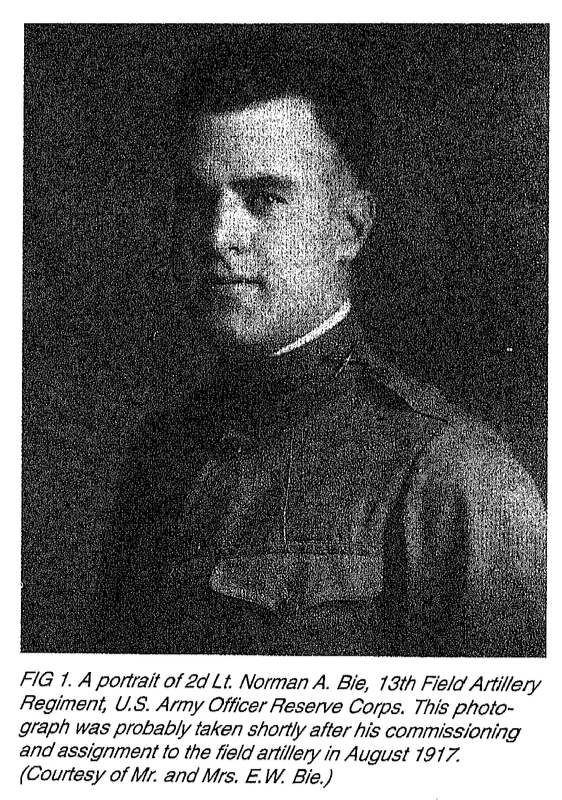
One day during the late summer of 1918, as night began to fall over the scarred battlefields of eastern France during World War I, a young American lieutenant began to keep a diary recounting his experiences on the front lines. Why he chose to begin the journal is a mystery, as he had already been at the front for more than a month, seeing action in both the Aisne-Marne and Oise-Marne offensives. But whatever the reason, for more than five weeks that soldier, 23-year-old 2d Lt. Norman A. Bie of Battery B, 13th Field Artillery, kept a faithful record of his role in the momentous events surrounding him. His diary, recently rediscovered by members of his family some eighty-two years after it was written, provides a fascinating glimpse of that period. It faithfully recounts the long stretches of boredom, punctuated briefly—but sharply—by intense action; the hard work and, at times, the almost mind-numbing lack of sleep; the hunger and constant exposure to the elements; all complicated by the risk of facing death at any time, anywhere.
Bie (pronounced “Bee”) was born in Tampa, Florida, in 1895. His father, Otto N. Bie, had emigrated to the United States from Norway in 1883 and worked as a civil engineer and steamship captain for the U.S. Army Corps of Engineers. In this capacity, the elder Bie conducted many of the earliest surveys and dredging operations on both the east and west coasts of Florida as master of the dredges Suwanee and Florida. Young Norman frequently accompanied him on these expeditions, including one special operation in 1910 that raised the sunken battleship Maine in Havana Harbor. Later, Norman attended the Porter Military Academy (now the Porter-Gaud School) in Charleston, South Carolina, graduating with honors in 1912.
After graduating from Porter, Bie returned to Tampa. He declined subsequent appointments to both the U.S. Naval Academy in Annapolis in 1914 and to West Point in 1916 in order to pursue a career in real estate. Shortly after war was declared with Germany in April 1917, Bie enlisted and was sent to Officer Candidate School at Fort McPherson in Atlanta, where he attended one of the first OCS classes. On 15 August 1917, after a three-month course of instruction, he was commissioned a second lieutenant in the Officer Reserve Corps and was assigned to the 13th Field Artillery Regiment, then stationed at Camp Stewart in El Paso, Texas. Bie was initially assigned to Battery E of the regiment, then later to Battery B.
In December, the 13th was assigned to the newly formed 4th Artillery Brigade of the 4th Infantry Division, and moved to Camp Greene, North Carolina, where it underwent training under the supervision of both French and British military advisers. By early June 1918, the 4th Division was deemed ready for action, and by the following month had been shipped off to France, where they went into camp and received additional training from the French Army.
When its period of training ended in July, the division was sent to the front. Bie and the 13th Field Artillery seem to have first seen action on the night of 5–6 August, when the 4th Artillery Brigade went on the line to support the operations of the 4th Division as part of the Aisne-Marne offensive.
By the time Bie began his diary on the last day of August 1918, his unit had seen almost three weeks of continuous action on the front lines. At about that same time, the commander of the AEF, Gen. John J. Pershing, was preparing a grand offensive, the first to be organized, led, and fought by American forces. Pershing planned to concentrate his 450,000-man U.S. First Army in a major offensive designed to wipe out the German-occupied St. Mihiel salient south of Verdun.
As Lieutenant Bie’s diary opens, the 13th Field Artillery was preparing to support the U.S. 26th Division in the Rupt Sector along the western edge of the St. Mihiel salient.
Aug. 31, 1918. Camped in woods at Eurville—aeroplane discipline becoming more strict. Sent a cable to Dad. Have been on the march for two nights from Blancheville, where we were billeted after arriving from Chery, thru Beuvardes and Chateau Thierry, etc. Part of way on train was sick for two days—one on march and one at Blancheville. Spent one day, while billeted, at Chaumont, where I had my pay voucher cashed, and ordered new uniform, and obtained part new equipment. Everything I had was salvaged by mistake at Chateau Thierry, but they may be paid for as we were ordered to make out lists of what we lost. Noted today that the 4th Division is mentioned for bravery. The infantry certainly won that for us. My hat is off to the Infantry. Saw General Pershing and a group of Congressmen at Chaumont. The B.C. [Battery Commander]—Lt. Vanderhoof—is in hospital—Lt. Gann in charge of battery—I am 2nd in command.
Sept. 1. Camped in woods 3.6 kilometres from Brillon and a few kilometres from Bar-le-Duc after marching all night from Eurville. We were not ordered out of Eurville until 22 o’clock, and as we had to harness and break camp in the dark we did not leave until midnight. Our march was about 15 miles. We had harnessed and broken camp at 18 o’clock once, and were ordered to unharness and make camp again at 19:30. When the second orders came we were all disgusted but there was no grumbling, although we were all tired and sleepy. Animals had no water today. We slept like logs, all except the cooks and the guard. Are moving at 19:30 tonight further toward the front.
Sept. 2. Marched all night from last camp and went into camp near Vaubecourt. Have been on the march now for four nights going anywhere from 15 to 21 miles each night. March discipline is excellent. We are near Verdun now and can see the effects of the severe bombardment the Germans subjected this region to four years ago. The little town near where we are camped is absolutely demolished, and everything is in ruins. The inhabitants have returned but are living in the cellars and ruins of their homes. Stray graves dot the countryside, some in tilled fields, some in gardens, some almost in the road, but all are respected whatever their location. Aeroplane camouflage is one of the things we are working on for perfection for we are evidently going to try to give the Huns the surprise of their lives and it must be a surprise to them. American planes are scarce but the French are evidently coming to our rescue in all we are lacking, as usual, and will co-operate in the air. We spent most of the day resting up, for we are all very tired—horses in particular. They have done well, the animals, and as we have only a few—95—we must take care of them.
Sept. 3. Watered the animals last night under cover of darkness at 23 o’clock. Again this morning at 4:30. Slept until 12:00. Stayed in camp the rest of day reading & studying. Expect to see the colonel tonight in order to get permission to go to Bar-le-Duc to wire some money home. The men have been eating green apples and shooting craps all day—a bad combination. They are in good spirits and are ready to go to the front again—but need new clothes badly. We hope to be supplied tomorrow and it will not be too soon for some have only what they wear. There are some very disagreeable men in the battery—a worthless lot—that we are trying to get rid of. It would be a good thing for the battery if we do. We changed First Sergeants and mess sergeants today. Both new men are good. My “striker”—Clement—a Texan—just brought my supper consisting of slum, bread and coffee. A good meal for troops in the field. The officers have canned goods along, so we have a few extras. The men also buy extras, and as they were only recently paid they have plenty. Sgt. Kilcoin of “E” Battery, my first outfit, paid me 20 fr. [francs]. I had loaned him in Tours—a good man and one of my friends. I will have to buy new winter underwear as all mine was lost at Chateau Thierry. Now for the slum.
Sept. 4. Obtained permission to go to Bar-le-Duc to wire money to America. Capt. Sullivan drove me in the colonel’s car. Tried to make purchases for Gathing, Gann, Davis, Ardiff and myself before the captain returned but could not. Everything in Bar-le-Duc is very high and you can obtain very little. The town was pretty well demolished but there remains a good many buildings. Expect I will have to stay overnight.
Sept. 5. Stayed in Bar-le-Duc last night—no lights at the hotel which caused me to run into a half-opened door and about break my nose. Took dinner with a Red Cross captain—a very interesting man—a veteran of the Cuban and Philippine wars, a Ph.D. of Chicago U. [the University of Chicago], etc. Spent all day and most of my change buying things for the lieutenants of the battery. Met Bill Taliaferro from Tampa accidentally and found out that he came over in the same convoy that I did—he sailing on the Leviathan—ex-Fatherland—and I on the Great Northern. He was in a hurry and so was I so we had to make the conversation snappy. Left Bar-le-Duc at 17:30 on a narrow gauge. It took me three hours to travel 26 kilometres—no—22 for I walked the other 4. Arrived in camp and everyone was asleep, so I had to talk myself to sleep as lights are not permitted and it was “pas possible” to read. Sent mother a necklace with a nenette and Rintintin—charms against the Big Berthas—attached. Also an artillery ring.
Sept. 6, 1918. Wrote letters to Mother, Georgie Le Doux and Virginia Bullard. Gathing and Gann off on a reconnaissance toward the front. Held an inspection and general police of camp. Received word that we would probably move out tomorrow and go in support of the 28th Division, plans having been changed. We also expect to fire for 22 hours solid in preparation for drive on Metz—probably. Took water call at 21 o’clock and expect to take it again at 4 in the morning.
Sept. 7. Am writing this on the 8th while mounted waiting to pull out of a woods to make a march of 15 kilo[metre]s to our position. We moved out of our camp last evening at 19 o’clock and marched 22 kilometres to the woods we are in now. It rained all the way and we were all soaked. Very unpleasant. It is dark now and I cannot see to write further.
September 8th. We pulled out of the woods used for a camp at about 22:15, being delayed by a piece from “A” Battery sliding into a ditch. It rained all night and we were delayed for four hours on the road by traffic. Very cold and disagreeable, particularly during one long halt of about two hours when there was no chance for exercise. We have a very good position now, but with wet roads it was difficult to enter. We are 4 kilometres from the front line trenches. Very short distance for heavy artillery. However, if the weather doesn’t hold us up the Front will soon be out of our range of fire. Let us hope so anyhow. There are about 48 batteries now covering a sector of 1 mile front. We have besides large naval guns—many. If we don’t blow the Dutch off the map it will be because they have as good shelters in this sector as the French. I cannot get it into my head why the French were willing to put so much time on building shelters when they could have been fighting. Some of the positions must have taken six months’ work to complete. With the amount of energy expended put into fighting the Germans ought to have been pushed across the Rhine. I am afraid our French friends only fight when they have to, but we must admit they can do something when forced to it. They are like a bunch of kids with all their medals, red pants, and other regalia, but I suppose they must have it. It all seems so funny to me that I don’t feel that any American should say a thing harmful about the French. For if it hadn’t been for their generosity we would have had no guns nor horses for our artillery and we would be negligible as combatants. Also airplanes. Too bad about them. If we had as many as was promised by now it would have been much nearer to a finale.
Sept. 9–10–11–12–13. We have been so busy that I had no time to write up the days. First of all we went into a half-prepared French battery position which required a great amount of work to complete for our purposes—not in making it more safe against shell fire but in doing the things that were necessary to enable us to open fire on the Boche. First of all our guns weighing four tons and more had to be run into their pits by hand and as it had rained for four days solid the ground was exceedingly soft. We finally got them in by using rolling hitches on the wheels and using all cannoneers. Then we had to dig trail pits in the solid rock as there is only a very shallow layer of mud, or earth as it probably is once in a while, over the rock stratum. Also we had to cut branches and make mats for the gun wheels and the hardest job of all was to cut down and top enough trees to enable our guns to shoot at an elevation low enough to reach the German trenches. We cut in all about 75 trees and dug our trenches with 3 axes, 4 short shovels (very small), 3 short picks (also very small) and 2 FOLDING SAWS. It was raining all the while and we had had no breakfast and not over 5 hours sleep in forty-eight. Our men were absolutely exhausted but willing to a superlative degree. At dusk two field officers came around and of course, had fault to find. The only thing we had not done was to dig emergency trenches near the guns, although we had shelter 30 feet away. But it had to be done, so we were ordered to work the men all night until the trenches were dug, the order being obeyed but not in a strict sense as we ran only a pretense at digging, first because it was impossible to dig in solid rock at night without light and again because our men were at that time forced to their utmost. I thought it best that as many as could should get a little sleep, if they could, lying in the mud and water—and they did—for one hour and a half. Then an ammunition train came up bringing 360 rounds of shells, powder, fuses, and primers. As it was dark beyond any degree and raining it took them until five thirty to get it all off of the trucks and into the dumps. Then we had breakfast, and afterwards began another day’s stretch by hauling the ammunition to the guns, digging the emergency trenches, and clearing further our field of fire, still raining, all wet and without rest. This continued all day. By the way, the field officers mentioned that there was no use in babying our men when they ordered us to dig all night. At 8 o’clock I, being executive, posted the gun crews and sent the others to bed. We knew we would open fire this night, so I kept one crew with everything in readiness having one of each kind of shell with one of each kind of fuse and one of each powder charge prepared so as to be able to get the first shot off in record time, which is quite an item in Field Artillery. At eleven-thirty 26 trucks of ammunition drove up, while it still rained, and they had to be unloaded. We called out the men and unloaded them where they stopped, as there was no hope of maneuvering them to the dumps on account of the mud. At 22:30 Lieutenant Gann phoned down from the Command Post to be ready. I was. At 1:03 I got the command “FIRE,” having received data just previous in the same message. At 1:08 the first shot was fired—the five minutes being occupied in taking off sight and muzzle covers, in placing the trail, in lighting our aiming stake, and loading. Twelve minutes later “A” Battery got off their first shot. We had schedules to fire from “H” hour, 8 o’clock H minus 7, making it 1 o’clock to “H” hour, firing in all 315 rounds per gun, and we had 90 at each gun. I called out the 2nd gun crews, ammunition detail, and called for volunteers from the cooks, and non-commissioned officers. They all came.
All. And they carried the shells and powder on their backs continuously until ten o’clock on the next morning practically without lights, as we only had candles and five lanterns (candle lanterns). The dumps were located anywhere from 50 yards to 600 yards away from the guns, which made a man walk about ¾ of a mile to get only one round from the last dump. It was very muddy and many slipped with the shells on their backs, and we are heavy artillery, and I know many were hurt, but no one asked to be relieved except one and I have him spotted for asking not to even be called out because he couldn’t get his shoes on. They kept on, these men and my cannoneers until the last shot was fired at 11:30 the next morning, we having received six missions to support the infantry after they went over the top at 8:00, which occupied 3½ hrs. We have 130 men at the guns and they all worked, and my heart comes up even now in my throat when I think of the guts that many of them, most of them, and a few in particular, showed. It rained up until one hour before the infantry went over and then the sun came out strongly, which I am sure was God-sent, for it had rained a week or more previous. We had done all the work, at least my boys had, from 17 o’clock the night before until 11:30 on only a few crusts of bread which I had brought up. But we had breakfast as soon as the last shot was fired and then cleaned our guns and then slept. On the 13th we were ordered out at 1:00 A.M. to get the guns out of their pits, and be ready to follow the doughboys. We got the guns out at 7:00 working all the time, and we have not moved yet—10:30 A.M.
Sept. 14. Because our infantry has gone so far forward we could not catch up. We hear our corps—the 5th and the 1st—have one to four German divisions bottled up—that the French are driving with us on METZ, and that our infantry had gained their third day’s objectives in 36 hours. All successful. My battery was not fired on, although I thought we were going to be once when I heard a shell burst nearby. I learned that it was a premature explosion from one of “A” Battery’s guns just behind us 200 yards. We are now being held here to await rain or darkness and expect to move towards Metz.
Sept. 15. As we were held in camp for further orders, I obtained permission to visit some of the captured territory. “No man’s land” was one mass of shell holes and shell-torn trees. All of the trenches were well demolished, and plainly showed effects of intense bombardment of light artillery. I visited battery positions mostly. We were told there was an abandoned battery of 77’s nearby but we could not locate them. All dugouts and shelters presented evidence of hasty abandonment, so I entered three or four, having no fear of traps and mines. There was a great wealth of all kinds of supplies, clothing and ammunition. I brought back a pair of field shoes, some letters, and a walking stick. The letters were Austrian, and proved to us the report that we were opposed by mongrel troops. The shoes were too small and I threw the stick away. Machine guns and material were much in evidence. The roads were all excellent except for one strip of the “Grand Tranchée” leading across “no man’s land.” We were ordered not to hit that road as we wanted to use it—if we advanced. We pulled out at 18:30 and arrived at Ancemont at 2:45. There was confusion in getting into our camp and we did not get settled until 6:45. This was due to our being the last in order of march.
Sept. 16. Rested all day after going to Ancemont and scouting up something to eat. The provosts gave me a breakfast with fried potatoes and jam which was the best I have had in a long while. Returned to town at 20:00 but could buy nothing, however the cooks at an officers’ mess fixed us up with a second supper. They were very nice and accommodating, and wanted first-hand information of the drive. Saw papers for the first time in several days.
Sept. 17. Spent the day in resting principally. Cleaned harness and guns in the afternoon. German planes were in evidence all day and we expected the night bombing which we got. The bombs were intended for the mobile hospital right next to us, though I think, as more bombs landed near it than us. Read a Saturday Evening Post for the first time in many days. Had good food also for the first time.
Sept. 18. Had gas masks drill for an hour—issued clothing—watered animals at 4:30 and 18:30—wrote home. Received 2 letters from home. Terrell has been assigned to “B” Battery as commander. Had a long talk with him at night.
Sept. 19. We had quite a little bit of excitement today. Word percolated thru the Regiment that our Major-General had made some remarks to the colonel about “sacrificing” him if he could not handle the Regiment. The colonel has said not a word but we are sure something was said for the 13th has been nagged and nagged until it appears to us as if it was being done solely for pestering us—thru spite. We all call the Brigadier an old Grandma and his staff a Sunday school. They are certainly the worst excuse for their jobs I hope ever to see. We feel that the Major-General has been duped by the Grandma into spiting us, not us, our Colonel who we all worship, for personal reasons. Our colonel is one of the grandest men and most courtly gentlemen I have ever known and he has us all with him. A division is none too good for him and he deserves one. If someone could only put the division commander wise we think he could see the error of his ways. Saw an air battle which was exciting—2 Huns—5 Americans, one plane forced down and a Major and Lieutenant captured—the other shot down.
Sept. 20–28. A whole week has passed without an entry—something I never intended should happen, but it is very hard to sit down and write up the day when you are tired and also when there is no light. We left camp on the 22nd and made an 18 kilometer march to a woods on top of a steep hill. The climb up the hill was very long and hard and we did not get in until way along in the morning of the 23rd—about 9:00. We got no orders to pull out that night—for which we were very thankful. The next day we spent in cleaning guns and harness and also in resting. We moved forward that night—24th—over a camouflaged road with two lines of troops going forward. We all expected a shelling which never came. The march was long because we made so many stops en route. Finally, we arrived at our battery position which had been prepared for us by a detail of the B.C. and thirty men who had come forward 3 days previous. It, while practically in the open, was good for we were just behind a crest and near a road with the additional facility of having a small narrow gauge railroad running by the battery for hauling ammunition. Lt. Gann took the tour of duty until 7:00 the next morning and I put my cot and four blankets in the pit that was to be the Executive’s Dugout. Before I had gone to bed we got some gas, and I was further disturbed during the night by having a few small shell fragments drop in on me. The guns were in position next morning when I went on duty and I spent the day in getting up 1200 rounds of powder and shells and in preparing the guns to open fire. We had to be very careful of our camouflage discipline as there were a good many German planes up. We had no shells fall near us at all. Everything was ready by 17:00 and I went off duty at 19:00. The Corps Artillery opened up at 1:00 and raised quite a racket. The batteries forward including ourselves opened up at 5:30 and ceased firing at 9:30—which was zero hour. We did no more firing at all.
I was called out that night to get ammunition for the 2nd and 3rd battalions which went forward. I had a very hard time getting it up, as the road over “no man’s land” and beyond was not fit for traffic. I arrived, however, at about 6:00, it taking me two hours to go about six kilometers. I was relieved when I arrived and walked back to my battery—an awful walk. The roads were jammed—the ambulances not even being able to get the wounded back. I stopped to beg a meal from an officer who I saw eating one. The officer was Colonel Daly of the 4th Engrs. [Engineers]. He fixed me up and we had a long chat about some Engineer officers I know. He also told me Colonel Spalding—a friend of my Dad’s—was near here. I will look Col. S. up.
I have spent the day reading and sleeping and we are awaiting orders to go forward but do not hope to get any as we are soon to be relieved by 14th Division. Wrote to the folks.
To Oct. 4. We remained in position waiting our turn to get up to the other two battalions—but that turn did not come until the night of the 3rd. I made a trip on the 2nd to Lemmes for rations—returning on the 3rd. We came forward and stopped at Cuisy from 9:00 till 16:30 when we pulled out for our advance position. We have only 68 horses and the hills were steep—so in cases where we encountered steep hills we had to put ten of our worn-out animals on a piece. The Germans tried to shell us with gas and H.E. [High Explosives] coming thru Septarges but did us no damage. We had a hard time pulling into position, as it was dark and the roads were muddy. We had one horse to fall in the dugout. We pulled our guns in and then went to bed—roosting on the ground. Many shells came over, killing one of our few animals and wounding another, but doing no harm to our soldiers. Many infantrymen were hit during the night. I got up once to look for a dugout but as I stepped into my cold wet rubber boots, sans socks, I decided to go back to bed, which I did and I worried no more about the shells as I didn’t awaken until about 7:00. We are in a pocket—Germans on three sides—so we have to be careful. They are shelling us all the time but have done no damage so far—one man had Lieut. Gathing’s horse shot out from under him this morning. I have been resting all day—while the position is being prepared—and am going on duty tonight. “E” Battery had a shell with a quick fuse hit a tree near Battalion Headquarters and wound 3 men. Very unfortunate. I think it was due to carelessness as I looked over their position this morning and the field of fire did not look clear to me. Too bad. I bought a case of jam and other things to eat at Lemmes so we are living high on corn willy etc.
I thought I had finished for today but I just had the pleasure of seeing a Boche plane come down—my first. Bullets from the machine guns fell within a few feet of us and as I had no helmet I put a blanket over my head. All the machine and anti-aircraft guns—hundreds—opened up on the ten or fifteen Boche planes overhead and they were firing at us with their machine guns, when out of the clouds came an American plane and the Dutchman he was after went down in flames. We all were hallooing our heads off for it looked good to us. A German went after the American but did not get him—brave boy. Some excitement. “Hooray for our side”—a Battery “B” slogan.
Oct. 5. I rested all day yesterday—read, ate, and slept a little—also watched air battles. Saw a shrapnel hit a plane direct and the plane came down in pieces. Some of the boys went over and viewed the remains. There was a pilot and observer. We are told we have the mastery of the air now. I suppose figures show it—even figures can lie. We had a severe gas attack for about an hour and a half last night—one man gassed severely, a number including myself feeling the effects of it for a while. They played the old game of sending over sneezing gas which irritates the nostrils and throat, then sending the lethal variety. The former prevents the latter’s detection. We got a continued shelling but had only one man injured. We seem to get our full share of injuries but no deaths—thank God. One of our pieces is out of action, so we received no counter-battery work. Two of the pieces received missions to fire between 19:30 and 5:30 of the 6th, firing only 65 rds. each. Slow and tedious. We started the doughboys over again on the morning of the 5th firing from 5:30 to 7:30—hoping to straighten the line and take us out of a pocket. No news as to our success yet as nothing has been passed down. We captured a number of prisoners though, for we saw them pass.
Here the diary abruptly ends. According to Bie’s family, he was ordered at this point to stop making entries for fear of giving possibly sensitive information to the enemy should he be captured.
Although the American offensive in the Meuse-Argonne became bogged down due to difficulties in logistics and terrain, elsewhere British attacks on the German Hindenburg Line proved decisive. By 5 October, the British had punched a hole through the German defenses and by 7 November, Pershing’s army had managed to cross the Meuse River and cut the vital German railroad line that carried supplies to the front. The Allies’ successes at this juncture induced the Germans to sue for peace, and on 11 November 1918 an armistice between Germany and the Allies was signed in the Forest of Compiègne at Rethondes.
When news of the armistice came, Bie was on board a ship waiting to leave France, having received orders to return home only a few days before. Later that same month he returned home to Tampa, where he received a hero’s welcome. An article from the local Tampa Daily Times newspaper quotes him at the time as saying:
“With the customary modesty of the returned soldier Lt. Bie disclaimed any credit for his services ‘over there.’ Accused of being modest, he said: ‘No, it is not modesty, only a realization that there are others who have done so much more.’ He paid a sincere tribute to the ‘dough-boys,’ or infantrymen, who, he said, have all the hardships, as well as the danger.
‘We all know that they had it much harder than we, for although we were heavily shelled, and had many casualties, we at least had a blanket to sleep in and could depend upon our coffee, and something to eat pretty regularly, whereas the ‘dough-boy’ in close combat can neither sleep nor eat, and must suffer unspeakable discomforts.’”
After short stints at Camp Meade, Maryland; Fort Sill, Oklahoma; and Camp Zachary Taylor in Louisville, Kentucky, Bie was honorably discharged from the Army on 3 September 1919. He then returned to Tampa, where he resumed his career in real estate and became actively involved in a variety of other ventures. Later, he moved to Indian Rocks Beach in nearby Pinellas County, where he became one of the earliest permanent settlers and where he established a successful real estate business, from which he eventually retired. Married in 1923 to childhood sweetheart Rita Monrose, with whom he had six children, he died in 1974 at the age of 78.
The editors wish to thank Mr. E.W. “Billy” Bie, his wife Shera Haight Bie, and other members of the Bie family (Ellen, Norman Jr., Rita, and O.N. “Cappy” Bie), the Florida State Archives and Florida Department of Military Affairs, Florida military historian Robert Hawk and Tampa Tribune columnist Leland Hawes.
Notes
- John B. Wilson, “Influences on U.S. Army Divisional Organization in the Twentieth Century,” Army History, 39 (Fall 1996): 1–3.
- George C. Marshall, Memoirs of My Services in the World War, 1917–1918 (Boston: Houghton Mifflin Co., 1976), 145–49.
- S.L.A. Marshall, The American Heritage History of World War I (New York: Dell Publishing Co., 1964), 341.
- John Keegan, The First World War (New York: Vintage Books, 2000), 411.
- Diary of Lt. Norman A. Bie, Battery “B,” 13th Field Artillery Regt., 31 August–5 October 1918, in the possession of E.W. “Billy” Bie, youngest son of Norman Bie, Indian Rocks Beach, Florida; military record and honorable discharge certificate of Norman A. Bie, in the possession of E.W. Bie.
- Shera Haight Bie, comp., “Our Family Heritage: Bie,” unpublished manuscript, 5 September 2000, 19–22, 26, 36–37 (hereafter cited as Bie, “Our Family Heritage: Bie”); “Returns With Honors,” Tampa Tribune, 8 June 1912; “Local Lad Wins High Honors At Charleston,” Tampa Times, 8 June 1912; diploma of Norman Albion Bie from the Porter Military Academy, Charleston, South Carolina, 5 June 1912, in the possession of E.W. Bie; “Capt. O.N. Bie: ‘Capt. O.N. Bie, Pioneer Port Engineer, Dies,’” Tampa Morning Tribune, 23 July 1930; “Capt. O.N. Bie, U.S. Engineer in Tampa, Dies,” Tampa Daily Times, 22 July 1930. Concerning Norman Bie’s early adventures, the Bie family also has in its possession tape recordings made by him that provide fascinating accounts of his life aboard the dredges. See Norman A. Bie Sr., taped presentation to the United Spanish-American War Veterans Reunion in Memphis, Tennessee, on the USS Maine doorknob recovered in 1910, recorded in Miami, 1968; taped reminiscence of life aboard the dredges Suwanee and Florida from 1902–1907, recorded in Memphis, 25 December 1970, copies of which are in the Heritage Village Library and Archives, Largo, Florida.
- Bie, “Our Family Heritage: Bie,” 37–40; “Seventeen Tampans Get Commissions At Ft. M’Pherson School,” Tampa Morning Tribune, 14 August 1917; and Norman A. Bie diary, 3 September 1918. There is some discrepancy as to whether Bie graduated from the first or the second OCS class at Fort McPherson. See “Bie Home on Furlough” and “Two Tampans Arrive in France with Artillery,” from unknown local Tampa newspapers in Bie family scrapbook, in the possession of E.W. Bie. The battery is the smallest and most basic unit of the field artillery. Equivalent to a company in the infantry and a troop in the cavalry, it is generally composed of four guns manned by four officers and about one hundred men.
- Janice E. McKenney, comp., Field Artillery, Regular Army and Army Reserve, Army Lineage Series (Washington: Center of Military History, United States Army, 1992), 207; Christian A. Bach and Henry Noble Hall, The Fourth Division: Its Services and Achievements in the World War (N.p., 1920), 1–65 (hereafter cited as Bach and Hall, Fourth Division); Army War College, Order of Battle of the United States Land Forces in the World War (Washington: GPO, 1931), 63 (hereafter cited as Order of Battle).
- Bach and Hall, Fourth Division, 115–17; Order of Battle, 67; Calvin D. Linton, The Bicentennial Almanac (Nashville: Thomas Nelson, 1975), 296 (hereafter cited as Linton, Bicentennial Almanac).
- Order of Battle, 67–69; Laurence Stallings, The Doughboys (New York: Harper & Row, 1963), 203–07 (hereafter cited as Stallings, The Doughboys).
- Bach and Hall, Fourth Division, 149–50; Order of Battle, 69.
- Eurville is a small French village located about 53 km. (approximately 33 miles) north of Chaumont along the Marne River. “Aeroplane discipline” refers to the fact that artillery batteries at the front were under constant threat of attack from German airplanes, and had to be carefully camouflaged in order to avoid detection.
- Here, Bie is referring to General Orders No. 143 dated 28 August 1918, in which General Pershing paid a glowing tribute to the men of the 1st, 2d, 3d, 4th, 26th, 32d, and 42d Divisions for their part in the Second Battle of the Marne.
- This reference indicates that Bie may have been present when General Pershing formally took command of the unified American First Army at his headquarters at Chaumont on 30 August. See Stallings, The Doughboys, 203.
- During World War I, American artillery regiments were typically organized to consist of six batteries, with four guns to a battery of either 75mm or, in the case of the 13th, 155mm caliber. Though batteries were usually commanded by captains, some were commanded by a first lieutenant, as seems to be the case here. Bie, as a second lieutenant, then became second in command or executive officer of the battery, which usually involved handling the paperwork, discipline, morale, and other routine administrative duties of the unit. See American Battle Monuments Commission, American Armies and Battlefields in Europe (Washington, D.C.).