Posted on

Lowes Musings

Was at a big box store over the weekend and found a few things I thought were amusing:

LAMP Stack – Iykyk

Oh, the irony –

This is a stupid selling point –

BUY THESE ROCKS THEY WON’T DECAY!

Though here is the crazy thing, rocks decay (erode) after millions of years.

Posted on

Phablet

For Valentine’s Day I got the wife a new phone. We had discussed the possibility of her getting an Ipad but the price was a bit steep. I was willing to take the plunge on an Ipad for her (and of course secretly use it when she wasn’t looking).

In the end, the Samsung Note 4 turned out to be a good option that combines the two (phone and tablet) into one device called a Phablet. She also looked at cases for the phablet and it turns out they make cases that resemble books for note. Though you must be a Moby Dick fan as that is what their bookcases come in.

From a historical perspective, I do find it odd that in the recent history of mobile phones, the race was to go from the Gorden Gecko Motorola DynaTAC of the 1980s and make it smaller. The film Zoolander even had a joke about the ever-decreasing size of phones:

Now it appears technology is racing to make the phones bigger.

Posted on

Costa Family History

I thought it might be a good time to start some articles on my site about my family’s history. I don’t want to say too much but there are some interesting nuggets worth sharing.

Great-Great Uncle John Noonan – Paternal Grandma’s side

I am related to John Noonan (grandma’s side of the family) who was the brother of Sara Noonan. Sara Noonan (who married and became Sara Noonan Curly) was my grandma’s, Virginia Costa, grandma.

Great-Great Uncle John Noonan fought in the Civil War. He enlisted Oct 1st, 1861 in F company, 47th Regiment out of Peoria Ill at the age of 24. He was 5’11 with blue eyes and light hair. He was born in 1837 in Ireland.

According to the roster, he achieved the rank of Corp. and was mustered out of service on Oct 11th, 1864.

He may have been wounded in some battle and/or spent time in the Andersonville Prison camp. However, he would have to have been paroled at some point. Though, prison exchanges seemed to have stopped by June of 1864. So it’s unlikely.

Far more likely is that since he is supposed to have signed up at the start of the war the original terms of his enlistment ended on Oct 11th, 1864 and he was discharged. If that’s the case then he saw lots of action under Grant as he moved to take Vicksburg and beyond.

Great-Great Uncle John Lieb – Paternal Grandma’s side

I am related to John Lieb (might be written as Leib; grandma’s side of the family). He was born in Austria in 1834 and ended up in The Town of Lake which was eventually absorbed into Milwaukee, Wisconsin. He became a private in the Union Army on Oct 13th, 1864. He was with Company D, 12th Wisconsin Infantry. For a complete military history of the unit see: Chapter XX: Regimental History -12th Infantry.

We think he enlisted either as a substitute and/or to gain citizenship.

He likely came to the unit as a replacement and just marched with Sherman to the Sea. Then turned north into South Carolina and North Carolina. Mostly engaged in a handful of minor skirmishes. Was at the Battle of Bentonville but was not engaged. 

He was mustered out on June 16th, 1865.

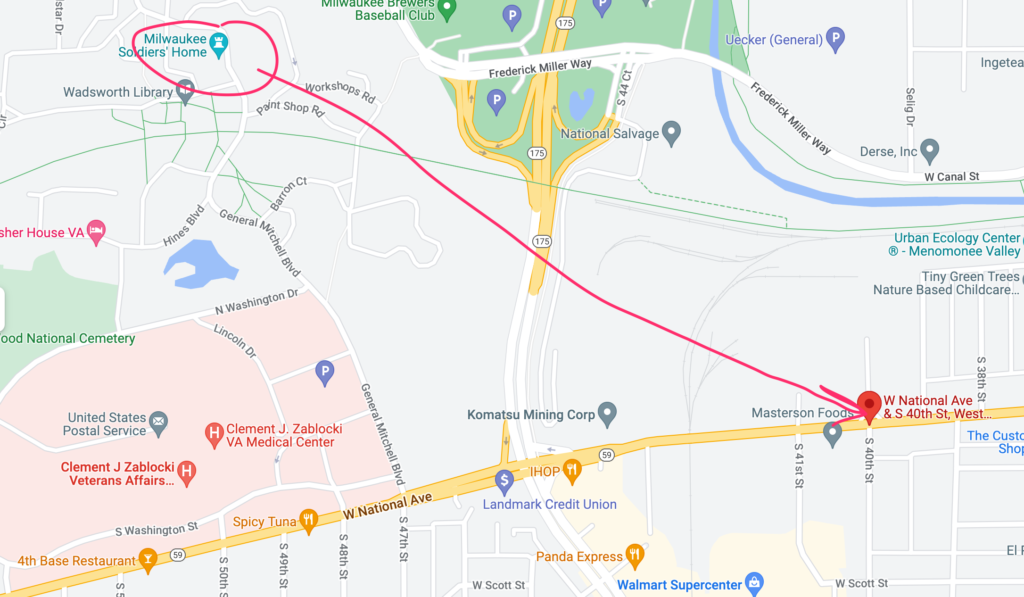
At some point, he ended up at the Northwest Branch of the National Home for Disabled Volunteer Soldiers (DVS) in Milwaukee. This is now essentially the modern-day Milwaukee VA Medical Center location.

He died around 1:32 am on Feb 14th, 1904 at the intersection of National Ave at 40th St in Milwaukee. We think he left his home and walked a mile to the saloons that were once located on the street. Got drunk and passed out on the tracks.

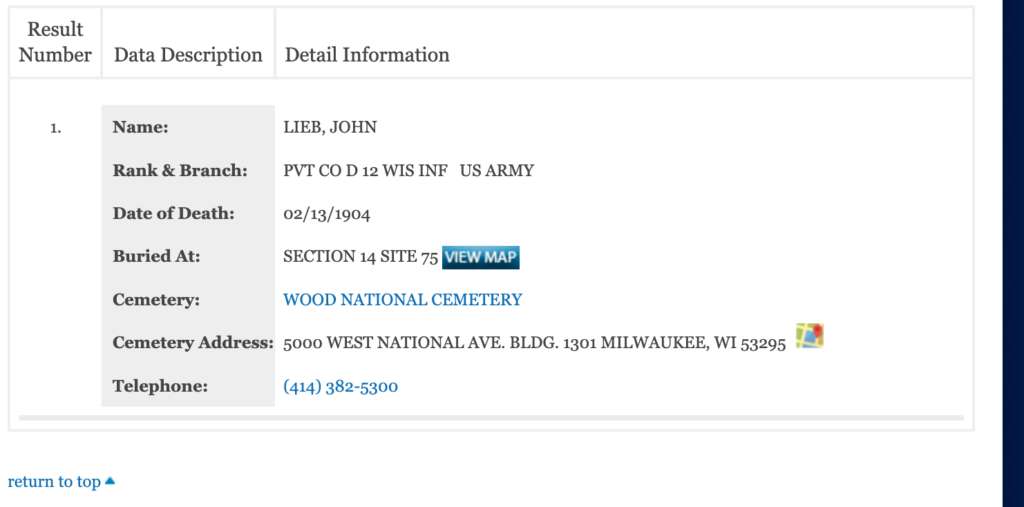
He was buried at SECTION 14 SITE 75 of the Wood National Cemetary in Milwaukee Wisconsin.

Coroner’s Report of Death

Below is a transcript of the report:

At 1:30 am on the morning of Feb 14th, 1904 a streetcar of the Milwaukee Electric Railway was heading west on National Ave at 40th St. It was a dark night. There were no street lights on this segment of the tracks and all the saloons along the way had closed for the night.

The streetcar (trolly) was described by Andrew Burns, the motorman as “one of the new large double-truck cars.”. It was empty of passengers except for the motorman and the conductor. The motorman had his front window opened. It had snowed earlier in the evening and now had turned cold. “I could get a better view of the tracks that way, he said.

It was 1:32 am as the #294 car headed downhill towards the Veterans’ home. “We were going about 5 or 7 miles an hour”, the conductor Gustau Will testified. The headlights on the car were working and as the streetcar rolled along the motorman said, “I saw a man lying lengthwise between the two rails that I was running on.” Too late to use any safety devices, the streetcar struck and killed the man. The body was taken to the home but they could not revive it. The body was taken to the coroner’s office on Sycamore St. and East Water.

At the inquest the company commander, Cpt Edwin R. Parks identified the clothing from the victim of the accident as those belonging to John Leib, a member of the Veterans’ Home residence. The Captain described John as a “quiet man at the home”, however, he did have a reputation of “going out and getting full”. The death was listed as accidental.

My Notes on the transcript

  1. East Water Street is now called North Water Street.
  2. See the Milwaukee Electric Railway Wikipedia article for more information.
  3. Double-truck trolley cars were developed around 1900 so Milwaukee got some a couple of years later to replace single truck ones. These double-truck cars are bigger and can hold more passengers.
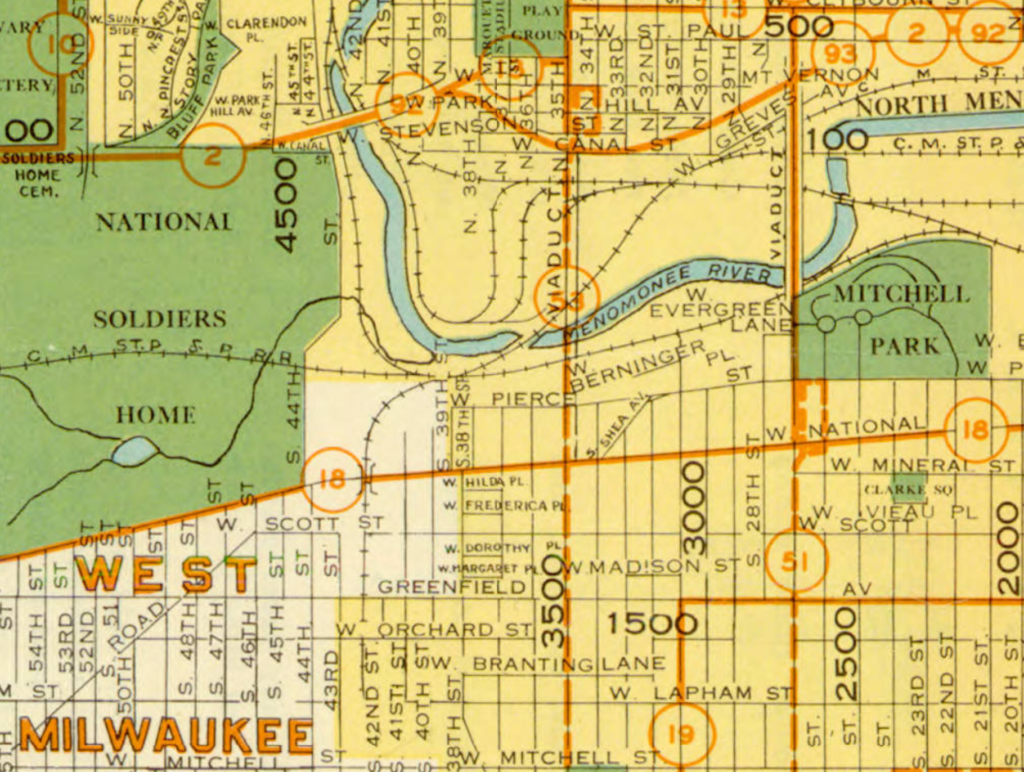
  4. According to a trolley map, it looks like there was a stop nearby along the route. Not sure if it means anything just something of interest.

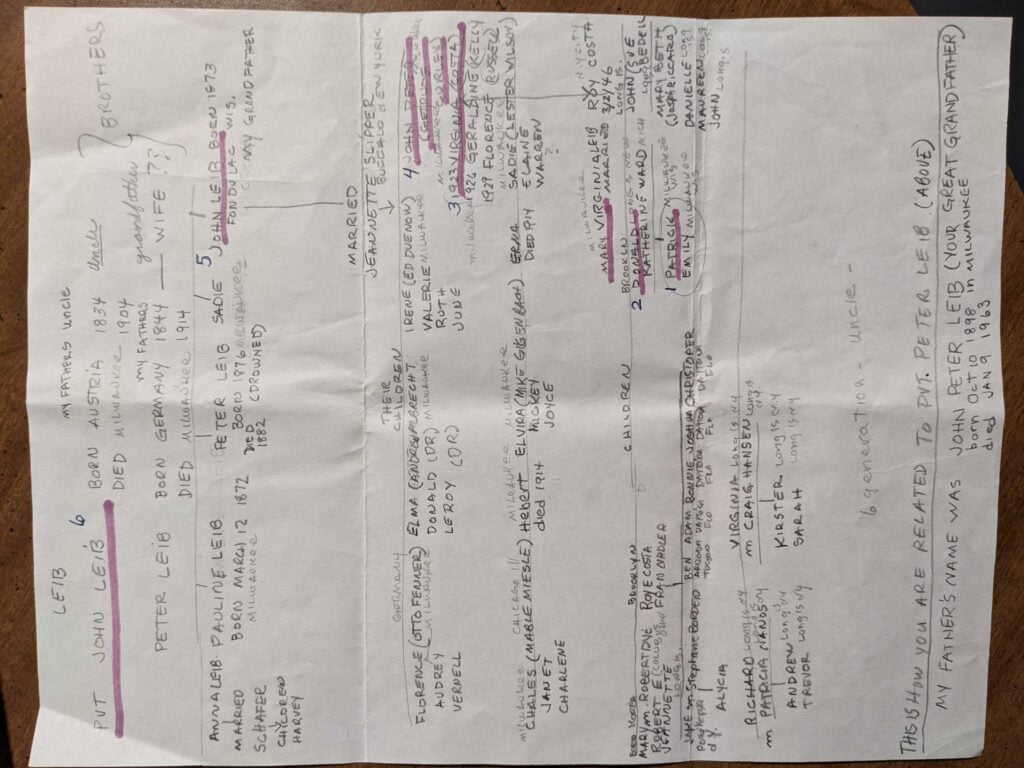
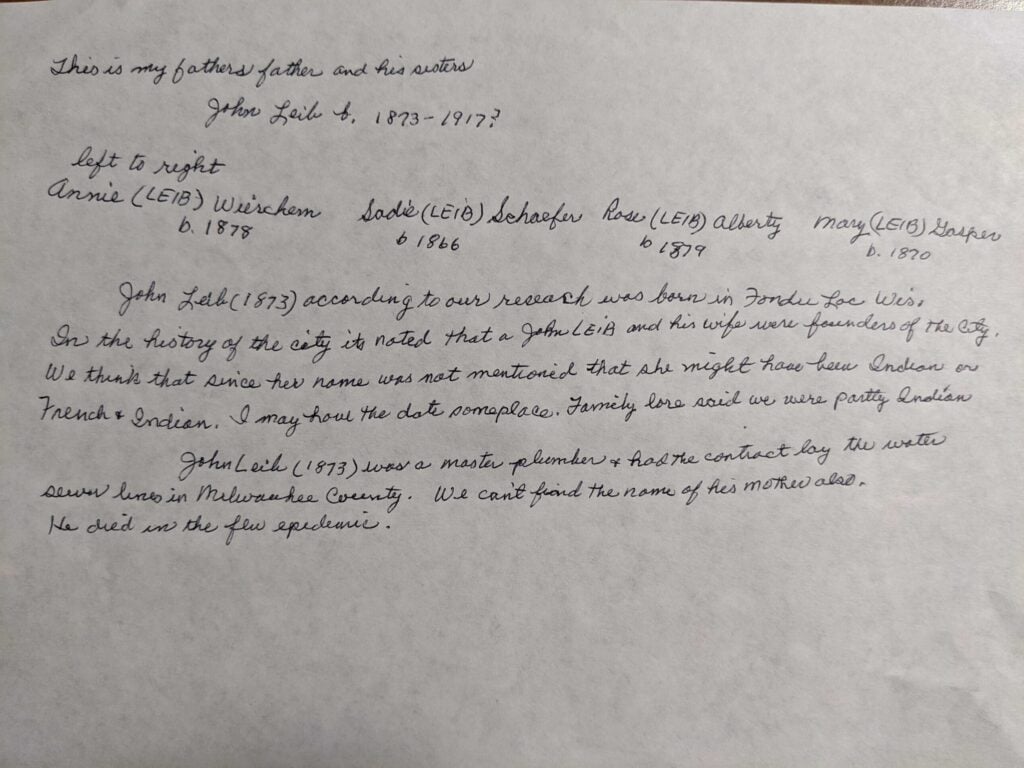
My maternal grandmother, Virginia sketched out a brief family tree below:

John Lieb

The John Lieb who fought in the Civil war as noted above had a child named John Lieb. He was born in 1873 in Fond Du Loc Wisconsin. According to my grandma, a John Leib and his wife are mentioned as founders of the city. I’m not sure it’s the Civil War John Leib as he was born in 1834 in Austria…and Fond Du Loc was founded in the 1840s. It could civil war “John Lieb”‘s dad (who probably was named John Lieb), though.

The John Lieb who was born in 1873 became a master plumber and had a contract to lay the water/sewer lines in Milwaukee County. He likely died in the Spanish Flu pandemic. He married Jeanette Slipper (born 1876 and died in 1928).

John Leib, Annie W

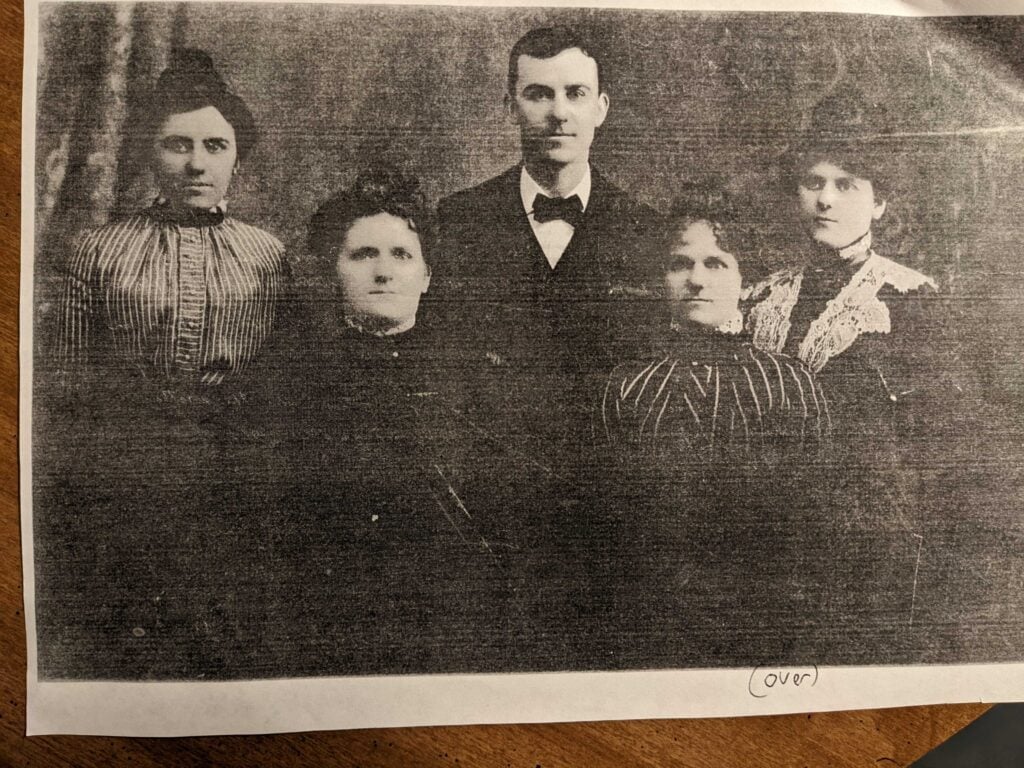
In the image above, it is a picture of Civil War John Lieb’s offspring. The people listed are from left to right:
Annie (Lieb) Wirshern born 1878
Sadie (Leib) Schaefer born 1866
John Leib born 1873
Rose (Leib) Alberty born 1879
Mary (Leib) Gasper born 1870

John Lieb and Sisters

The plumber John Lieb would go on to have a kid and name him John Lieb. This John Lieb was my grandma (Virginia)’s dad. This John Lieb was born in 1897 and died in 1963. He married Gertrude Curley (born 1896 and died 1971).

Great-Great-Great Grandmother – Paternal Grandma’s side

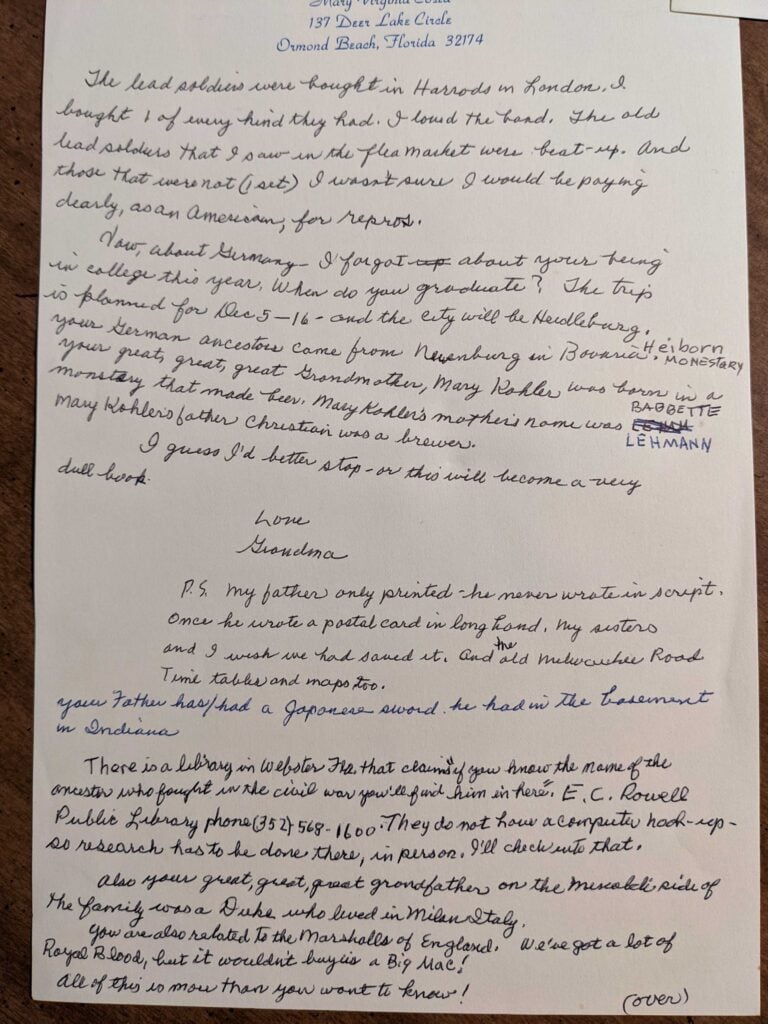
I am related to Mary (or Marie) Kohler who married Charles Slipper. Their daughter, Jennette Slipper married John Leib. According to my grandma, Virginia (maiden name Leib), Mary was born in a monastery that made beer. Mary’s mother’s name was Babbette Lehmann. Mary’s father was named Christian (probably had the last name of Kohler) who was a brewer.

According to my grandma, most of my German ancestors came from Neuenburg, a small city in Bavaria.

In the letter, my grandma seems to say Mary was born in the Heiborn Monastary but that doesn’t seem to exist? She might be referring to the Heilbronn as the city? That city has a Maulbronn Monastery. But Heilbronn isn’t located in Bavaria, it’s located in a different German state.

Great-great-great grandpa Giacinto Menoldi – Paternal Grandpa’s Side

On my maternal Grandpa’s side, there is a great-great-great grandpa called Giacinto Menoldi (who married Philipina Santoro) who was a duke in Milan. But the spelling of his name may not be clear…and there’s not much of a historical record of it?

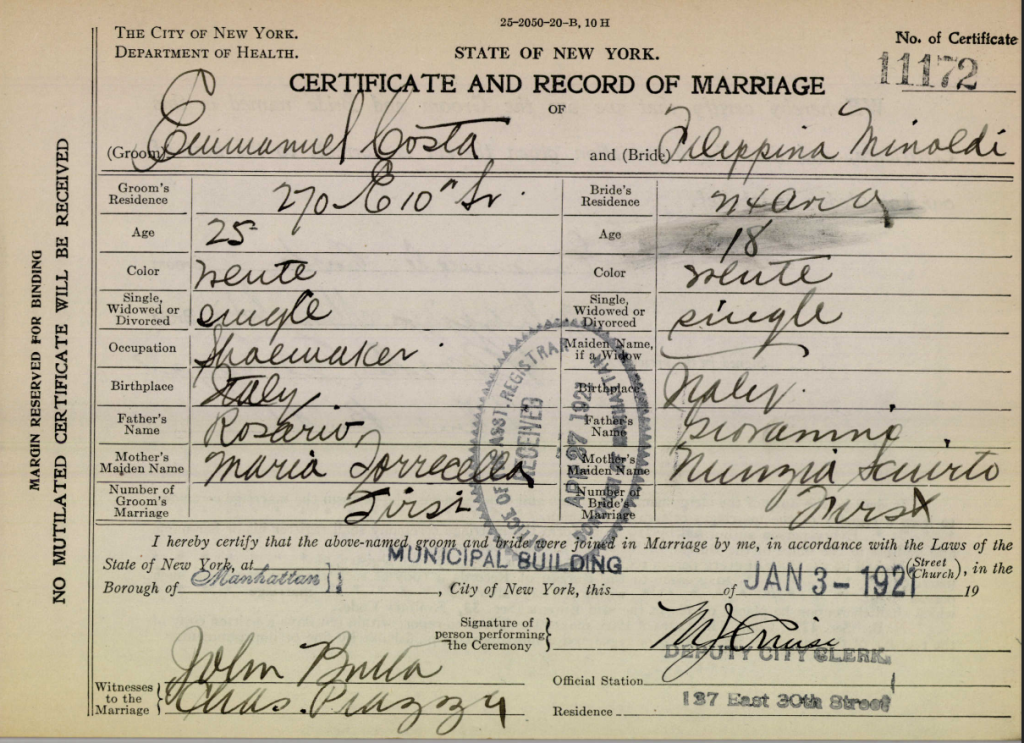
Great Grandpa – Emmanuel Costa

When doing some research I found his and Filippina Minoldi marriage certificate. They were married on Jan 3rd, 1921. he was 25 and a shoemaker and she was 19.

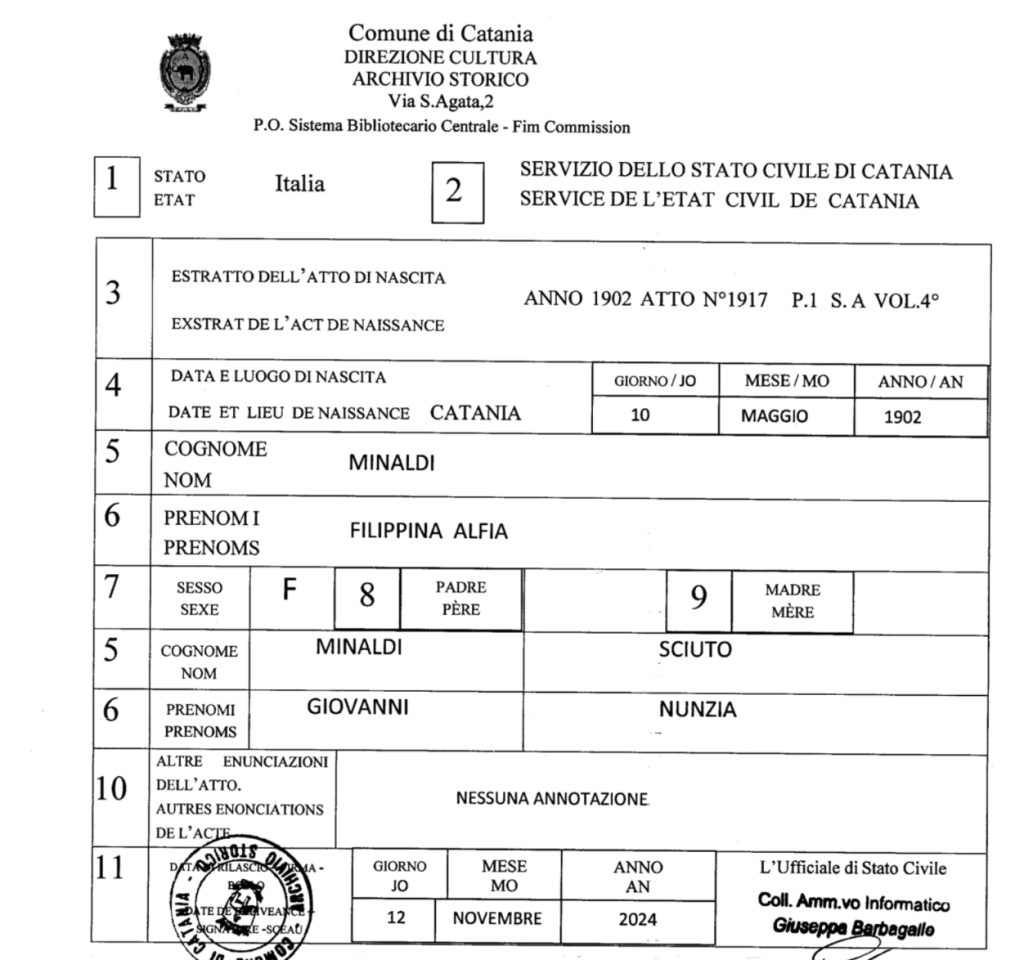
Great Grandpa – Filippina Alfia Minaldi

I was able to dig up her Birth Certificate –

When Costa First Appeared

The first time, according to Virginia, Costa appeared in records was in 1436 when Costa become a writer/recorder for the Vatican.

Costa Family Tree

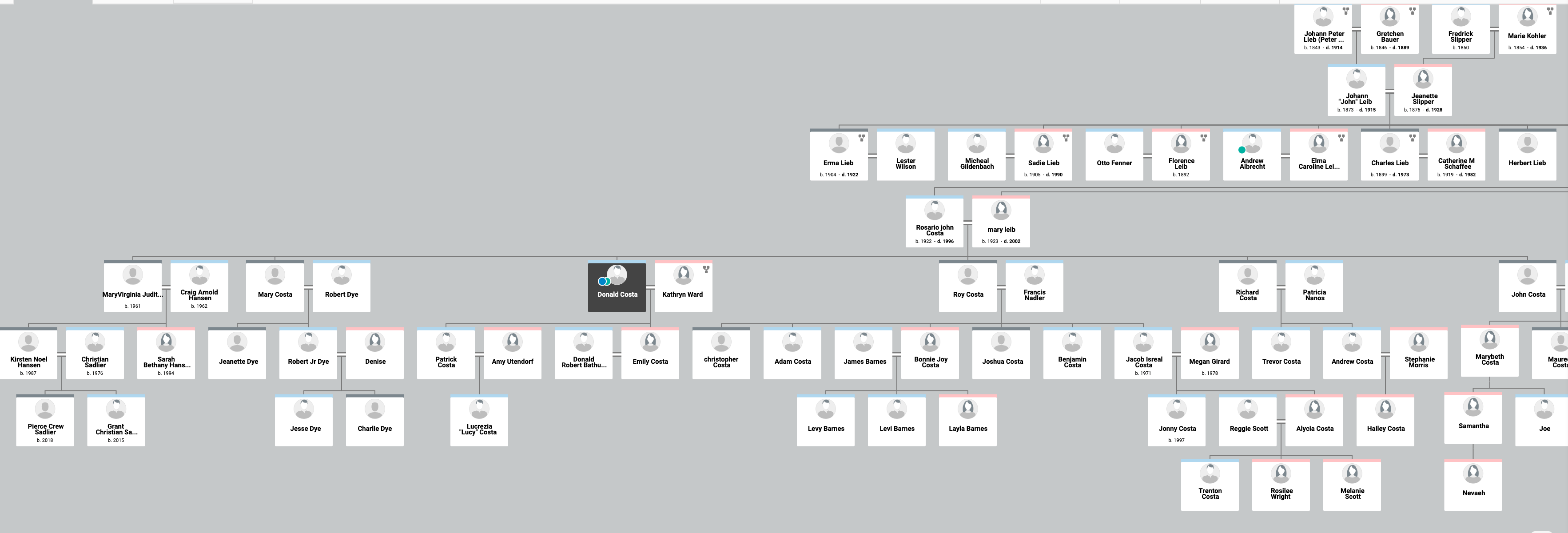
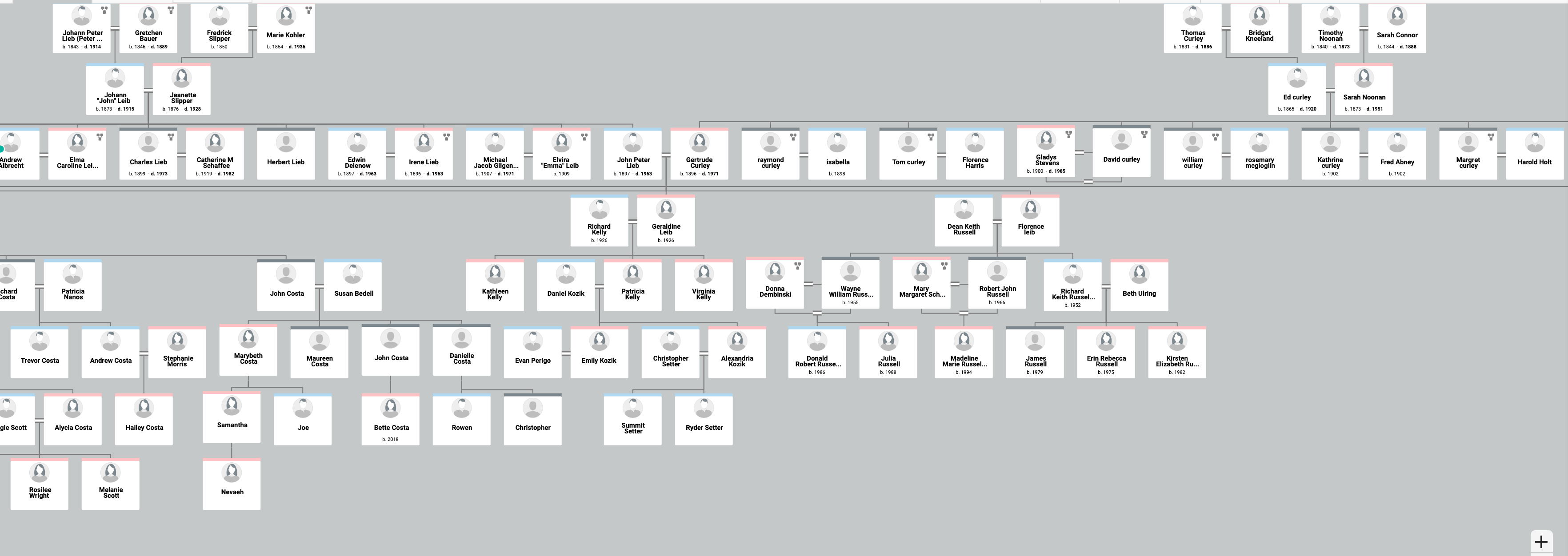
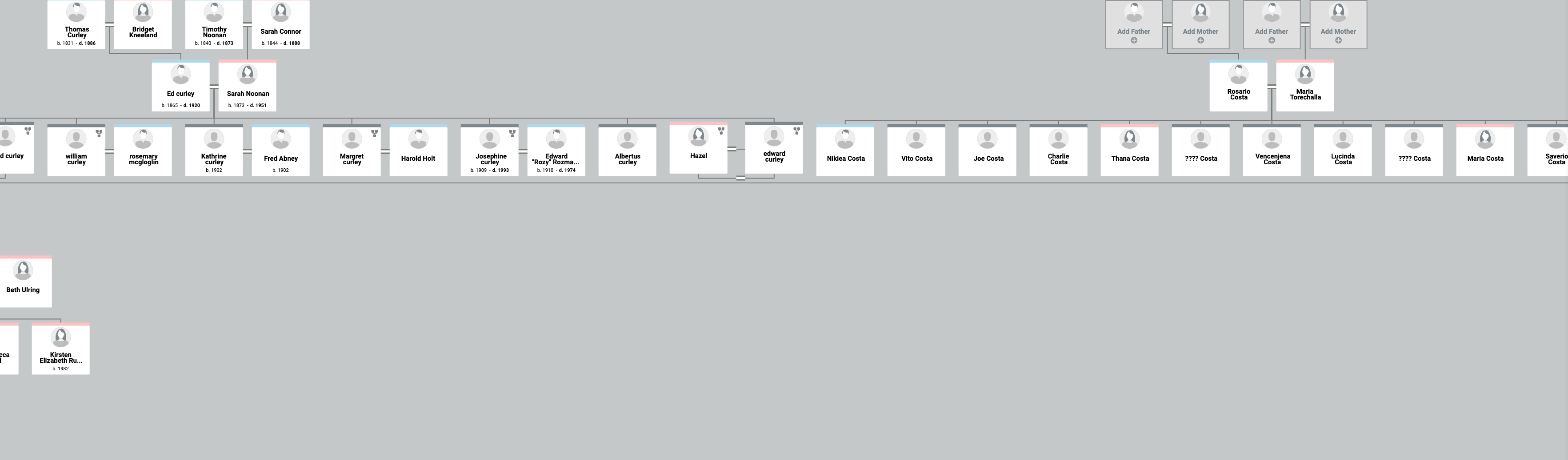
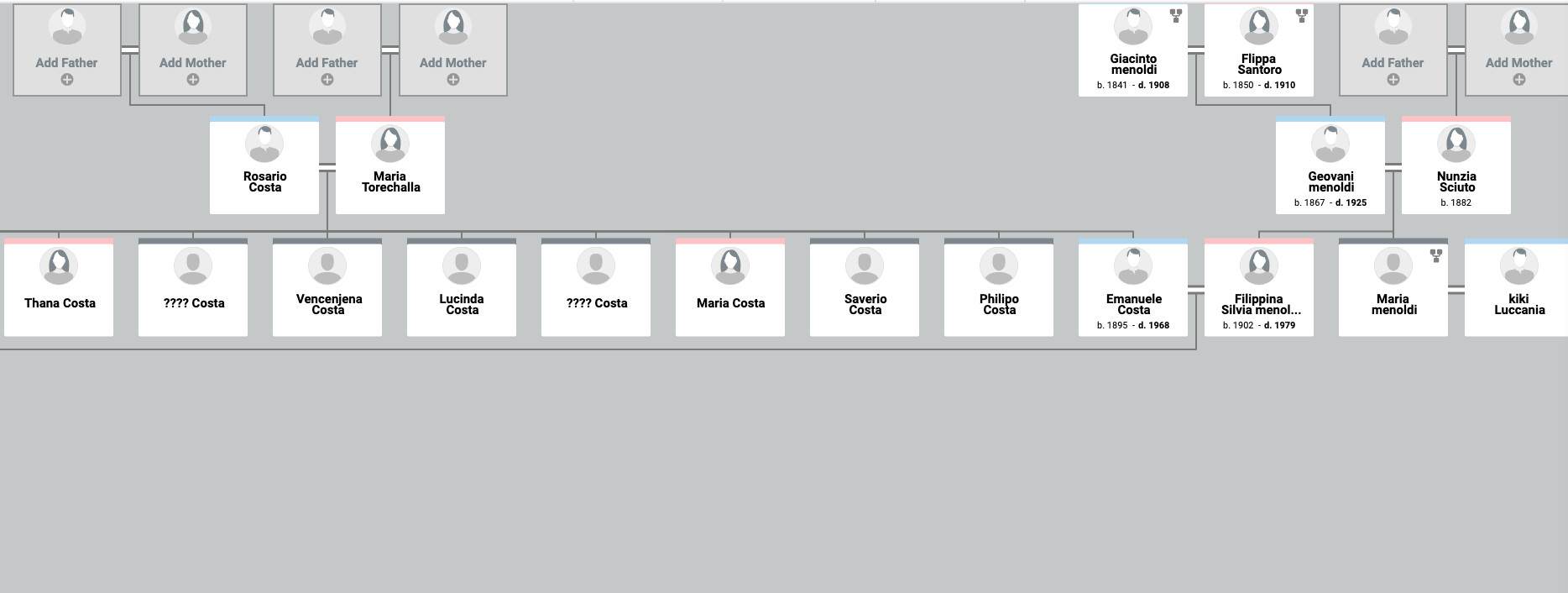
My dad created this Family tree based on his knowledge. It’s meant to be read from left to right. You can download the images to get a clear picture of the tree.

Costa Family Tree part 1
Costa Family Tree part 2
Costa Family Tree part 3
Costa Family Tree part 4
Posted on

Dad Jokes

Why didn’t the skeleton go to the dance?

He didn’t have anybody to go with.

Why can’t you trust an atom?

They make up everything

Why did the golfer bring an extra pair of socks?

In case he got a hole in one.

When was baseball first mentioned?

In the bible…in the big inning.

Where is Engagement Ohio?

Between Dayton and Marion.

When a horse loses its tail, where does it go for a new one?

A retail store!

Posted on

Poetry Collection

Every once and a while I come up with a poem or find some poems I want to share. This page will serve as a repository of them.

Folding Doors are not Mismatched

This is a poem that I came up with as I was taking some Farsi classes away from my wife for a Summer at the University of Maryland.

Folding Doors are not Mismatched

Same wood. Same paint. Same design.

Made together, for each other.

Strong.  Solid.

Folding doors, apart during the day, yet always near.

They see the world that separates them. 

Evening settles and they are reunited.

Doors of equal.

Strong.  Solid.

Folding Doors are not Mismatched

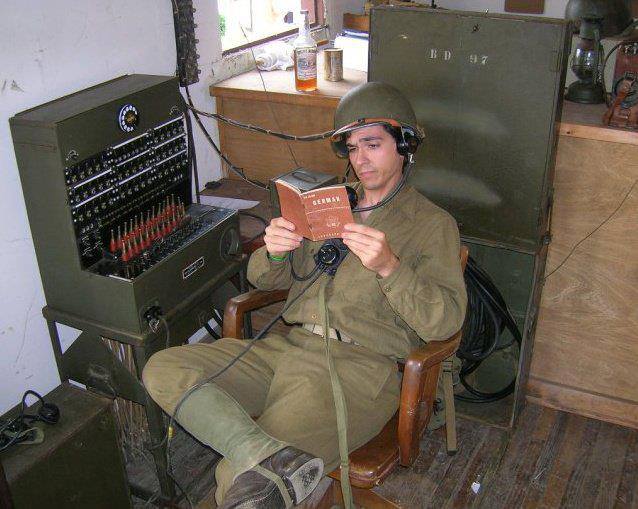
557th Signal Depot Company

The signal depot company was responsible for maintaining, repairing, and managing the signal corps equipment for a division. I’m not sure what division the 557th Signal Company was a part of. However, it seemed likely it was sent to the Pacific for a very brief amount of time.

Technical Sgt T/5 Bernard Stein composed this poem at the end of WW2. Reproduced below –

27 August 1945
A history (rough but right) of the 557th Signal Depot co., written for the boys by one of the boys.
0R APROPOETRY
By T/5 Bernard Stein.
On the first of April, year forty-four, There was born a group in tho Signal Corps.
The 557th was its name,
To run a depot, was to be its game.
A little, tough man by the name of Knight Was the officer chosen to show it the light.
He bellowed and blustered, but gave the group “sock”, Then, one fine day, he was replaced by Block.
This new Captain , who had come to the fore , Didn’t appear to know the whole score.
But the men he chose were an excellent lot; For this you’ll see later, a Majority he got.
It was in Camp Maxey, in that great Texas land, That this fine groups made its first stand.
They soldiered and studied and practised and sweat, TIll an “Excellent”, in ITP, they did get.
In that camp, they moved quite a bit, Till, It seemed, they’d cleaned every part of it. On 2 December, they did finally go
To Fort Sam Houston, near San Antonio.
There they worked in the depot; They lived very well; of their many good deals, the boys still do tell. Some even married, and their brides are there yet, While many still write to the gals, they there met.
None will forget the “Twin Palms”, cross the way,
It was “Don’t Fence Me In” and “Rum and Coke” every day. Each day at the depot,
they worked “racking up”
At night, the boys took off and tried “shacking up”
Then the Captain and some boys went off to schools, While the rest of Repair dept. [not sure if this is right]. displaying its tools. The boys then returned, a little bit sager,
But the Captain, Oh Glory, returned as a Major.

On 27 March, Fort Sam they did leave;
There was nary a man who did not grieve.
Their first impression of their new camp, Bowie, caused the boys, to cry aloud, “Phooie”.
Soon out in the field, the boys had to go
and those three weeks of bivouac moved, Oh, so slow. But again the men showed, what fine men they be, Because they got an “Excellent” on the UTP.
Soon after, the Major, at a formation one day, Stunned the boys when they heard them say,
“Now that the officers have seen you through-” That was a statement most untrue.

But the men laughed it off and got ready
then, For POE at a camp. named Stoneman.
On the 7th of June they hit the rail
lnto sunny Cal. they blazed a trail.
There they were greeted with shots in the arm.
So that many diseases could do them no harm.
But “short arm”inspections was what kept the boys stoppin, Till they believed that was our “secret weapon”.
Censorship came and the letters grew colder,
For you can’t emote, who they’re at your shoulder.
The censor, bescissored, roads what you write,
But the warm thoughts of home were there day and night.
Came the 15th of June, they marched to the pier,
The boys sounded merry, but some must have felt fear. The boat “Catalina”, took them to Frisco that day,
Then they boarded the “Mormacwren” and were on the way.
To remain at home it was now too late,
For they’d already passed under the Golden Gate.
But the lament of the “lame” still rose hopefully, “They’ll never pass me through POE”.
So off they sailed on the big blue sea Further and further from the land of liberty. The ship was
crowded and holds were hot, For 53 days they were a miserable lot.
If permission is granted to add chronology, Here are the stops they made at sea.
Pearl Harbor June 21
Eniwotok June 30
Ulithi July 5
Loyto July 9
Manila Bay July 15

On the 19th of July, an LCM came portside;
The men scrambled in for a short but rough ride.
They landed, then drove thru tho badly wrecked town, And in a depot, in tents, settled down.
For a while it looked like the unit would split,
As grabs were made for different part of it .
Meanwhile, the men, who they could, went out sight seeing , And even found bones of Japs who’d failed fleeing.
Then an assignment came through for them,
On 30 July they railed from Base X to M.
From AP0 75 to 70 they went
To perform the mission for which they were sent.
The duties they got were certainly clear,
For hadn’t they trained for more than a year? But alas, to work the Major couldn’t
for he was ordered to stay as just the C.O.
But just as the boys , their jobs began tending , The war most suddenly came to an ending.
Now the boys once more want to roam,
But this time, please God, let it be home

ANY QUESTIONS??

ODE TO A DEAR DEPARTED ITEM OF EQUIPMENT

Sergeant, dear Sergeant, great trouble besets me,
 To travail at last I must yield.
Make your statement of cost, for I fear I have lost
  My strap, carrying, bag, canvas, field.

Some dastard in o.d. has sabotaged me;
 My just ire cannot be concealed.
He has taken to flight in the dead of the night
  With my strap, carrying, bag, canvas, field.

I would rather be taken a prisoner at Makin
 Or be flayed ’til my life’s blod congealed,
Or go months without shoes than surrender or lose
  My strap, carrying, bag, canvas, field.

Wherever we’d go, in the rain, sleet, or snow,
 And in exhaustion I staggered and reeled,
Cross my shoulder ’twould ride, with the bag at my side—
  My strap, carrying, bag, canvas, field.

Heavy burdens I’ve carried, but never have tarried
 And my weariness was never revealed.
Oh, I’ll never forget my bag, canvas, musette
  And my strap, carrying, bag, canvas, field.

Now the bounties of Fate cannot expiate
 My sorrow, for someone has stealed—
And my blood it does curdle—my GI web girdle,
  That strap, carrying, bag, canvas, field.

Make your Statement of Charges, I’ll pay out the largesse,
 My Sergeant, for I am well-heeled.
But in anguish I sigh with a tear in my eye
  —For my strap, carrying, bag, canvas, field.


In the Army’s Standard Nomenclature Lists, equipment and materiel were itemized for accounting and record-keeping. The item designations, usually descriptively detailed, often came up with perplexing names.

Posted on

Crawlspace: 5 Important Considerations

My wife and I purchased a property here in Virginia that came with a crawlspace. Now, for those of you who are not from Virginia, houses here rarely come with basements. The houses are either built on a slab (a concrete pad that serves as the foundation with the frame built off of it) or a crawlspace (a space beneath the house that one must crawl under). Crawlspaces exist because the house has been elevated off the ground through the use of concrete blocks (thus creating a space beneath the house).

Crawlspace
Crawlspace (taken from www.foundationmaster.com

Slab
Slab (taken from How Stuff Works)

Following our purchase my wife and I had to do a lot of work in the crawlspace and from all of our work and research here is what we learned:


Continue reading Crawlspace: 5 Important Considerations